
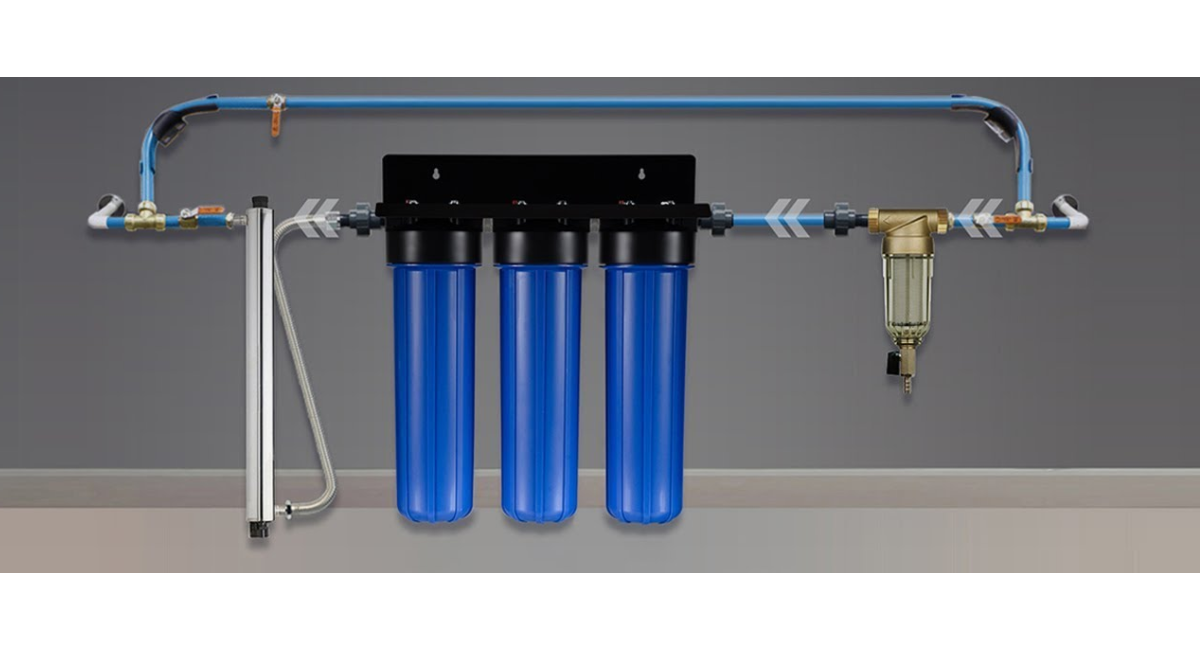
Quick Answer: A whole house water filter installs on the main supply line where it enters your home, treating every tap, shower, and appliance simultaneously. The right system depends on what is actually in your water — not what the marketing implies. A standard carbon block filter handles chlorine, VOCs, and taste. An iron filter handles well water with iron above 0.3 mg/L. A multi-stage system handles both plus sediment. Get a water test first. Then buy a filter rated to treat what the test found, at a flow rate that matches your household demand (typically 10 to 15 GPM for a 3-bedroom home).
Key Takeaways
- There is no single best whole house water filter. The right filter treats the specific contaminants in your specific water supply. Buying a filter before testing your water is how people spend $800 on a system that doesn’t address their actual problem.
- Flow rate matters as much as filtration rating. A filter that cleans to 0.5 µm but restricts your shower to a trickle has failed at its primary job. Match the system’s GPM rating to your peak household demand.
- NSF/ANSI certification is the only independent verification that a filter does what its label claims. NSF 42 covers aesthetic contaminants (chlorine, taste). NSF 53 covers health-effects contaminants (lead, cysts). NSF 58 covers reverse osmosis. A filter without certification is making unverified claims.
- Filter cartridge replacement is not optional maintenance. An expired carbon cartridge stops adsorbing contaminants and can begin releasing what it previously captured. Most whole house carbon filters need replacement every 100,000 gallons or 12 months, whichever comes first.
- The cheapest reliable whole house filter system runs about $200 to $350 installed for a basic carbon unit. A proper multi-stage system for well water with iron and hardness runs $800 to $1,500 before labor.
When my family’s well tested positive for coliform bacteria and arsenic at 12 µg/L — four times the EPA maximum contaminant level of 10 µg/L — I became the person at the water filter store who had actually read the test results. Most people standing there with me had not. They were buying based on what the box said, and the box said a lot of things that don’t appear in any NSF certification document.
That experience pushed me into environmental science and, eventually, into writing about water for a living. The whole house filter category is particularly messy because the range runs from $40 sediment spun-wound cartridges to $3,000 multi-stage iron elimination systems, and every product claims to be comprehensive. None of them are comprehensive. Every single one has a specific job description, and that job description lives in the spec sheet, not the marketing copy.
This guide covers what the filter types actually do, how to size one correctly, and what specific systems I consider worth recommending based on certification records and real-world installation results.
What a Whole House Filter Actually Does
A whole house water filter — also called a point-of-entry filter — connects to your main water supply line before it branches to any fixtures. Every water outlet in the house draws from the filtered supply: sinks, showers, toilets, washing machine, ice maker, outdoor hose bibs. This distinguishes it from point-of-use filters, which treat water at a single tap.
The practical advantage is coverage. One filter protects you from shower inhalation of chloroform (a chlorination byproduct that off-gasses in hot water) and from skin absorption of chlorine, not just from contaminants in what you drink. For households with chlorinated municipal water, this distinction matters more than filtration marketers typically explain.
What a whole house filter does not do: it does not guarantee potable water safety for all contaminants. A carbon block system will not remove nitrates, arsenic, or fluoride. An iron filter will not remove bacteria. A softener will not remove organic compounds. The category name suggests completeness. The engineering does not deliver completeness. Knowing this before you buy is the whole point of getting a water test.
Test Your Water Before You Buy Anything
The EPA recommends annual testing for private well users and advises municipal water customers to review their annual Consumer Confidence Report (CCR), which water suppliers are required to publish by July 1 each year. The CCR tells you what was detected at the treatment plant, not necessarily what arrives at your tap — distribution pipes add lead, copper, and sometimes bacterial contamination that treatment plants never see.
For a comprehensive baseline, the test I recommend is a certified lab panel covering: total coliform and E. coli, nitrates and nitrites, pH, total dissolved solids (TDS), hardness (calcium carbonate, mg/L), iron and manganese, lead and copper, arsenic, chlorine or chloramines (for municipal supply), and VOCs. A panel like this runs $100 to $200 through a state-certified lab and costs less than the margin of error on a wrong filter purchase.
Home test strips and handheld TDS meters are useful for quick checks and trend monitoring, but they do not replace lab analysis. A TDS meter at 450 mg/L tells you something is dissolved — it cannot tell you whether that something is calcium carbonate (benign) or arsenic (not benign). Do the lab test once, then use strips to monitor between full panels.
The Four Filter Types and When Each Applies
1. Sediment Filters
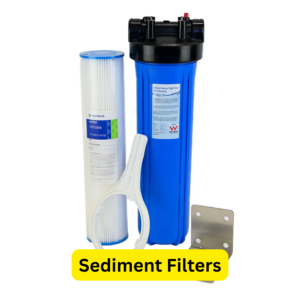
Sediment filters are mechanical: water passes through a porous material (spun polypropylene, pleated polyester, or ceramic) that traps particles above a certain micron rating. A 5 µm filter stops particles 5 micrometers and larger — sand, silt, rust flakes, turbidity. A 1 µm filter stops most cysts including Cryptosporidium and Giardia. A 0.5 µm filter stops essentially all particulate matter but requires higher water pressure to maintain flow.
Sediment filtration is almost always the first stage in any multi-stage system, because particulate matter clogs carbon and membrane filters faster than anything else. A standalone sediment filter costs $20 to $50 for the housing and $5 to $15 per replacement cartridge. It handles turbidity and rust but nothing chemical or biological.
2. Activated Carbon Filters
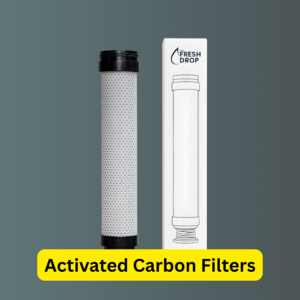
Activated carbon works through adsorption — contaminant molecules bond to the carbon surface and stay there. Granular activated carbon (GAC) is loose carbon in a housing; water flows through it at varying rates of contact. Carbon block is compressed carbon with a consistent pore structure; it offers more surface area and more predictable performance but restricts flow more than GAC at equivalent ratings.
Carbon filters certified to NSF 42 remove chlorine, chloramines, and taste/odor compounds. Carbon filters certified to NSF 53 remove additional health-effects contaminants including lead at certain concentrations, volatile organic compounds (VOCs), and MTBE. Not all carbon filters carry NSF 53 — check before assuming comprehensive coverage.
Carbon does not remove nitrates, heavy metals beyond lead at specific concentrations, fluoride, arsenic, or biological contamination. It has a finite adsorption capacity — once the carbon surface is saturated, it stops removing contaminants. An expired cartridge is not neutral. Some contaminants can desorb back into the water after the carbon is saturated. Replacement schedules exist for this reason.
3. Iron and Manganese Filters
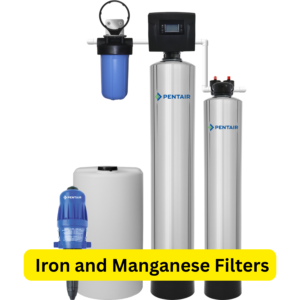
Iron above 0.3 mg/L stains laundry, fixtures, and dishes. Manganese above 0.05 mg/L does the same. Both are common in well water. Neither responds to carbon filtration alone. Iron filters use oxidation to convert dissolved ferrous iron to particulate ferric iron, which a sediment filter then captures. The oxidizing media — greensand, Birm, katalox — requires periodic backwashing and, in some systems, potassium permanganate regeneration.
Iron filter sizing requires knowing the iron concentration (from your water test), the pH of your water, and the presence of iron bacteria. Iron bacteria produce a slimy reddish-brown biofilm that clogs filters faster than dissolved iron alone and requires a different treatment approach (chlorination followed by carbon) rather than standard iron media.
4. Multi-Stage Systems
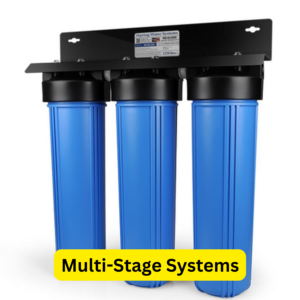
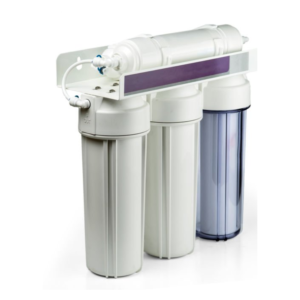
A multi-stage system combines filter types in sequence — typically sediment, then iron/manganese oxidation if needed, then carbon, then UV disinfection for biological contamination. The sequence matters: putting carbon before iron filtration clogs the carbon prematurely. Putting UV before sediment means turbid water blocks UV penetration and bacteria survive the lamp.
Multi-stage systems are the right choice for well water or for municipal water with complex contamination. They are also the most expensive option and the most maintenance-intensive. Budget for both upfront and ongoing costs before committing to a system.
Sizing: Flow Rate, Port Size, and Filter Life
The most common installation mistake is ignoring flow rate. A filter housing rated at 7 GPM (gallons per minute) installed on a 1-inch supply line serving a four-bathroom house will create pressure problems. A 3/4-inch house with two bathrooms can usually get by with 10 GPM. A house with 3 or more bathrooms, a dishwasher, and a washing machine should be sized at 15 to 20 GPM to avoid pressure drop during simultaneous draws.
Port size affects flow rate. Most residential whole house filter housings come with 3/4-inch or 1-inch ports. The 3/4-inch port restricts flow more than the 1-inch port. If your supply line is 3/4 inch, the 3/4-inch port matches. If your supply line is 1 inch, match it with a 1-inch port housing or you are creating a restriction at the filter that defeats the sizing math.
Filter life is measured in gallons or months, whichever comes first. A sediment cartridge in turbid well water may need replacement every 3 months. The same cartridge on clean municipal water may last 12 months. Manufacturers publish ratings at test conditions that may not match your water quality — use the rated life as a starting point and watch your pressure gauge. A 10 PSI drop from baseline means the cartridge is loaded and needs replacement.
The Shortlist: Honest Assessments by Use Case
Best for Municipal Water: Pelican PC600 (Carbon Series)
The Pelican PC600 uses a carbon block media rated to treat 600,000 gallons before replacement — roughly 5 years in a household using 300 gallons per day. It holds NSF 42 and NSF 61 certification and reduces chlorine, chloramines, and taste/odor compounds at the whole house level. Flow rate is 10 GPM on the 3/4-inch port model, 15 GPM on the 1-inch. List price runs $550 to $750. The replacement media costs $130 to $160 depending on the model series.
My honest assessment: this is a legitimate product doing what it claims. If chlorine, chloramines, and taste are your municipal water concerns, it addresses them at a reasonable cost per gallon over its rated life. It does not address lead, nitrates, or fluoride. If your CCR shows lead exceedances or you have an older home with copper supply lines and lead solder, you need an NSF 53-certified carbon block or a point-of-use RO system at the kitchen tap in addition to this unit.
Best for Well Water with Iron: SpringWell WS1
The SpringWell WS1 is an air injection oxidation system that handles iron up to 7 mg/L, manganese up to 1 mg/L, and hydrogen sulfide up to 8 PPM. It backwashes automatically on a programmable timer, requires no chemicals, and uses a control head that manages media regeneration without potassium permanganate. Flow rate is 12 GPM for the 1-3 bathroom model, 20 GPM for the 4+ bathroom model. Price runs $800 to $1,100 depending on size.
The limitation is specificity: this system handles iron, manganese, and H2S. It does not handle biological contamination, hardness, or VOCs. If your well test shows iron at 4 mg/L and bacteria at 3 CFU/100mL, you need the WS1 plus a carbon stage plus UV. SpringWell sells combined systems that stack these stages, which is the right approach for complex well water — but each added stage adds cost and requires its own maintenance schedule.
Best Budget Entry Point: iSpring WGB32B
The iSpring WGB32B is a 3-stage sediment plus dual carbon system. Stage 1 is a 5 µm polypropylene sediment filter. Stage 2 is a coconut-shell carbon block rated to NSF 42. Stage 3 is a second carbon block. Flow rate is 15 GPM. Replacement cartridges run $30 to $40 for the set. The system itself lists at $180 to $230.
The realistic assessment: for a rental property or a home on clean municipal water where the primary concern is chlorine taste and sediment, this is a reasonable purchase. The NSF 42 certification is real. Do not expect NSF 53 health-effects coverage because the system does not have it. If you are choosing this for well water, test first — if iron, bacteria, or arsenic is present, this system does not address those.
Whole House Filter vs Water Softener
These are not competing products. A whole house filter removes contaminants. A water softener exchanges calcium and magnesium ions for sodium or potassium ions to reduce hardness — it does not remove chemical contaminants, bacteria, or sediment. If you have both hard water and chlorine from a municipal supply, you need both, in the right order: filter before softener, because sediment and chlorine degrade the resin bed in a softener faster than clean water does.
| Water Softener | Whole House Filtration | |
|---|---|---|
| Problem it solves | Hardness calcium & magnesium | Contaminants, taste, odor, particles |
| What it removes | Hard minerals (ion exchange, swaps them for sodium/potassium) | Chlorine, lead, iron, sediment, sulfur, VOCs |
| You notice it in | Appliances, pipes, skin, hair, laundry, soap lather | Taste, smell, drinking water safety, staining |
| Does NOT fix | Bad taste, chlorine smell, lead | Limescale — filtration doesn’t soften water |
| Typical trigger | Scale on the kettle, spotty dishes, dry skin | Chlorine smell, rusty stains, a bad water report |
The full comparison — what each addresses, when to run them in series, and which to prioritize when budget forces a choice — is in the dedicated whole house filter vs water softener guide.
Maintenance Reality
The ongoing cost of a whole house filter is the cartridge replacement cost divided by the filter life in gallons. For a system with a $120 replacement cartridge rated to 100,000 gallons, the cost is 0.12 cents per gallon filtered. Across 300 gallons per day household usage, that’s $131 per year in media costs alone — before any service or labor.
Maintenance tasks beyond cartridge replacement: check the pressure gauge on both sides of the housing monthly. A pressure differential above 10 PSI between inlet and outlet indicates a loaded filter. Inspect the O-ring seal when changing cartridges; a cracked O-ring causes bypass flow where unfiltered water routes around the cartridge. Clean the housing interior at each cartridge change — sediment accumulates on the housing walls regardless of how clean the cartridge itself looks.
For the installation side — where to cut, how to handle the bypass valve, what to do when the supply line is CPVC versus copper versus PEX — the installation guide covers the full process with tool list and step-by-step detail.
If your concern is specifically the kitchen tap — drinking water quality in detail, not whole-house protection — the reverse osmosis system guide covers the under-sink options that reach contaminants a whole house carbon filter cannot. And for renters or anyone who cannot make permanent plumbing modifications, the countertop filter guide covers the no-install alternatives with honest performance numbers.
Frequently Asked Questions
Do I need a whole house water filter if I’m on city water?
Municipal water meets EPA drinking water standards at the treatment plant, but that does not mean it arrives at your tap in the same condition. Distribution pipes — many of them 40 to 80 years old — add lead, copper, and sometimes bacteria between the plant and your home. Chlorine and chloramines added for disinfection create byproducts including trihalomethanes (THMs) and haloacetic acids (HAAs) that the EPA regulates but does not eliminate. A carbon-based whole house filter handles chlorine, chloramines, and most THMs. Whether that justifies the cost depends on what your CCR actually shows and whether you have older plumbing. Many households on city water do fine with a point-of-use RO filter at the kitchen tap and skip the whole house unit.
What micron rating do I need for a whole house filter?
For municipal water with typical sediment, a 5 µm pre-filter ahead of a carbon stage handles most particulate. For well water with visible turbidity, start at 20 µm to avoid rapid clogging of a finer filter, then add a 5 µm stage downstream. For cyst removal (Cryptosporidium, Giardia), you need 1 µm absolute rating — “absolute” meaning the filter physically cannot pass a particle of that size, versus “nominal” which is a statistical rating that allows some passage. For whole house cyst removal, the NSF 53-certified 1 µm absolute cartridge is the specification to look for.
How often should I change the filter cartridge?
Manufacturer ratings are based on test water that does not necessarily match your supply. Use the pressure differential gauge as your primary indicator: when inlet pressure minus outlet pressure exceeds 10 PSI, change the cartridge regardless of the calendar. As a baseline, sediment cartridges in typical residential use need replacement every 3 to 6 months. Carbon block cartridges for municipal water typically last 6 to 12 months. High-capacity carbon systems (like the Pelican PC600) rate their media to 5 years at specific usage levels. Track your actual water usage and set a calendar reminder for whichever comes first: the rated gallon count or 12 months.
Can I install a whole house water filter myself?
Many homeowners install basic single-cartridge housings themselves, particularly on copper or PEX supply lines with accessible installation points. The tools required are basic: pipe cutter, compression fittings or SharkBite push-to-connect fittings, and a filter housing wrench. The considerations that push this toward professional installation: if the main shutoff is unreliable or inaccessible, if the supply line is galvanized (prone to cracking when cut), or if the system requires multiple stages with control heads (iron filters, softeners). The step-by-step process for a DIY installation is in the installation guide.
What is the difference between NSF 42 and NSF 53?
NSF International certifies water treatment products to specific standards. NSF 42 covers aesthetic effects — chlorine reduction, taste and odor, particulate. A filter certified only to NSF 42 makes no health claims. NSF 53 covers health-effects reduction — lead, cysts, VOCs, and other contaminants with established health risks. A filter certified to NSF 53 has demonstrated to a third-party testing organization that it reduces those specific contaminants by the amounts stated on the label. Always check the NSF certification database directly rather than relying on the box, because certifications can lapse and product formulations can change after certification.
Leave a Reply