
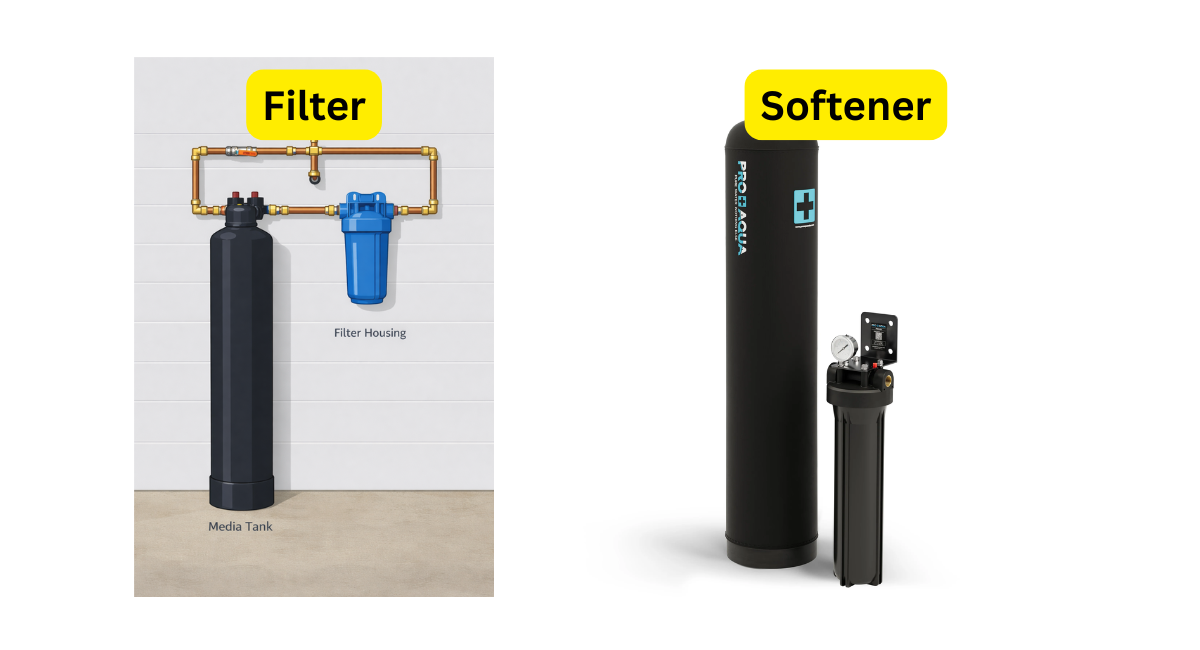
Quick Answer: A whole house water filter removes contaminants from water. A water softener removes hardness minerals — calcium and magnesium — by exchanging them for sodium or potassium. They solve different problems. If your water has chlorine, VOCs, sediment, or chemical contamination, you need a filter. If it leaves scale on fixtures, spots on dishes, or dulls laundry, you need a softener. If you have both problems — which most households with hard municipal water do — you need both, installed in the right order: filter before softener, so chlorine and sediment don’t degrade the resin bed.
Key Takeaways
- Water softeners do not filter contaminants. Softened water may still contain chlorine, lead, nitrates, VOCs, and bacteria at the same levels as unsoftened water. Softening and filtering are chemically distinct processes.
- Hard water is not a health risk at typical residential concentrations. Hardness between 60 and 180 mg/L as calcium carbonate is considered moderately hard by the USGS but carries no adverse health effects. The case for softening is about appliance protection and soap efficiency, not drinking water safety.
- Running a softener without a pre-filter in chlorinated municipal water shortens resin life significantly. Chlorine oxidizes ion exchange resin, reducing softening capacity over time. A carbon pre-filter extends resin bed life by 30 to 50% in heavily chlorinated supplies.
- Salt-free “softeners” (template-assisted crystallization or TAC systems) do not remove hardness minerals. They change the structure of calcium carbonate so it doesn’t deposit as scale. They do not produce soft water by the ion exchange definition and are not effective in all applications.
The water treatment industry has a strong financial incentive to blur the line between filtration and softening. Combination systems that claim to do both in one unit are common. Most of them do one thing well and the other poorly, or they’re a softener with a small carbon stage that handles chlorine taste but nothing more serious. Buying one of these without understanding what each component actually does is how people spend $1,500 and still have lead in their drinking water.
Here is the straight version of how these devices differ and when you need each one.
What Each Device Actually Does
Whole House Water Filter
A whole house filter (point-of-entry filter) treats all water entering the home by passing it through one or more filtration media. The media determines what gets removed. A carbon block filter adsorbs chlorine, chloramines, and organic compounds. A sediment filter traps particulate by physical size exclusion. An iron filter oxidizes dissolved iron to particulate form for mechanical removal. UV disinfection kills bacteria and viruses. Each stage handles specific contaminants and leaves others untouched.
Filtration does not change water hardness. A water hardness of 250 mg/L as CaCO3 entering a carbon filter exits at 250 mg/L as CaCO3. The filter has removed organic compounds, not minerals. This is the most common misconception I encounter from people who installed a whole house filter and still see scale deposits on their showerheads.
Water Softener
A water softener uses ion exchange resin — thousands of resin beads carrying sodium or potassium ions. As hard water passes through the resin bed, calcium and magnesium ions in the water swap places with sodium or potassium ions on the resin. The water exits with significantly lower hardness. The resin regenerates periodically by flushing with a brine solution, which recharges the sodium or potassium on the bead surface and discharges the captured calcium and magnesium to drain.
A softener does not remove chlorine, VOCs, nitrates, bacteria, lead, arsenic, or most other chemical or biological contaminants. Softened water has a different ionic composition — more sodium, less calcium and magnesium — but the same level of any other dissolved substance it started with. Testing softened water for contaminants other than hardness produces the same results as testing the unsoftened source.
| Problem | Whole House Filter | Water Softener |
|---|---|---|
| Chlorine / chloramines | Yes (carbon stage) | No |
| Scale / hard water deposits | No | Yes |
| Iron staining (dissolved) | Iron filter stage required | Partial (low iron only) |
| Lead (above action level) | NSF 53 carbon required | No |
| Sediment / turbidity | Yes (sediment stage) | No (clogs resin) |
| Bacteria / viruses | UV stage required | No |
| Soap lather / skin feel | No | Yes |
| Spotting on dishes / glass | No | Yes |
| Appliance scale damage | No | Yes |
Identify Your Problem Before Choosing
Hard water symptoms are specific: white mineral deposits on showerheads and faucet aerators, spots on glasses after dishwashing, soap that doesn’t lather well, stiff laundry, and reduced water heater efficiency (scale insulates heating elements, raising energy costs). If you see these, get a hardness test — a basic test strip measures hardness in 30 seconds and costs less than $1 per test. Water above 120 mg/L as CaCO3 (7 grains per gallon) typically produces these symptoms noticeably.
Filtration needs present differently: chlorine smell in shower steam, flat or chemical taste in tap water, visible rust or sediment, or a water test showing specific chemical contamination. These do not improve with softening. A household that installs a softener in response to chlorine smell will still have chlorine smell after installation.
Before purchasing either product, run a water test. A basic panel through a state-certified lab covers hardness, pH, TDS, iron, manganese, nitrates, coliform, and lead. For municipal water, review your Consumer Confidence Report first — every utility publishes this annually per EPA requirement — then test if the CCR shows anything concerning or if you have older plumbing. The test costs $100 to $200 and replaces guesswork on a $500 to $2,000 purchase.
Running Both: Sequence and Setup
Many households on hard municipal water benefit from both a whole house filter and a softener. The correct installation sequence is: sediment filter, then carbon filter, then softener, then distribution. The order matters for two reasons.
Chlorine oxidizes ion exchange resin. In a chlorinated municipal supply at 1 to 3 mg/L free chlorine (typical), resin beads exposed directly to the incoming water degrade at a measurable rate — studies on resin oxidation suggest 30 to 50% capacity reduction over 5 to 7 years in chlorinated water, compared to 10 to 15% in unchlorinated water. A carbon pre-filter ahead of the softener removes chlorine before it contacts the resin, extending resin life significantly. This is a maintenance and cost argument, not a water quality argument.
Sediment also damages softeners. Turbid water or water with particulate iron coats and fouls resin beads, reducing ion exchange capacity and clogging the control valve. A 5 µm sediment pre-filter ahead of the softener keeps the resin clean. If your water contains iron above 0.3 mg/L, add an iron filter stage before the softener — iron-fouled resin is expensive to clean and sometimes cannot be fully restored.
The Salt-Free Softener Question
Salt-free “conditioning” systems — marketed under names like NuvoH2O, Template Assisted Crystallization (TAC), and various electronic descalers — do not remove hardness minerals. The calcium and magnesium concentrations in treated water are identical to the source water. What these systems aim to do is change the crystalline structure of calcium carbonate so it forms aragonite (a non-adherent form) rather than calcite (the scale-forming version).
TAC systems have peer-reviewed evidence of scale reduction in laboratory and controlled field conditions. Electronic descalers (magnetic or electronic pipe clamp devices) have significantly weaker evidence and are not recommended by any water treatment professional organization I am aware of. The practical result of either: existing scale may dissolve gradually, and new scale formation slows. The water does not feel “soft” by the sensory definition — soap behavior and laundry feel remain unchanged because the calcium and magnesium are still present. If soft water feel is the goal, a TAC system doesn’t deliver it. If scale protection for a water heater in a low-sodium diet household is the goal, a TAC system is worth considering over a traditional salt softener.
Cost Comparison
A basic whole house carbon filter system (single stage, 3/4-inch port, 10 GPM) runs $200 to $400 installed with a DIY installation on a straightforward supply line. A multi-stage system with sediment, carbon, and UV runs $800 to $1,500 installed professionally. Ongoing cost is cartridge replacement: $30 to $150 per year depending on media type and replacement frequency.
A traditional ion exchange water softener for a 3-bedroom home runs $600 to $1,200 for the unit, plus $200 to $400 for professional installation (most softeners require installation at the main line, often near the water heater in a crawl space or basement). Ongoing cost is salt: a household using 150 gallons per day in hard water (15 grains per gallon) will consume 8 to 12 lbs of salt per week, roughly $15 to $25 per month at current salt prices.
If you need both, budget $1,500 to $3,000 all-in for a combined filter-plus-softener installation, depending on water complexity and labor rates in your area. The full breakdown on whole house filter options and how to pick the right system for your water type is in the whole house water filter guide.
Frequently Asked Questions
Does a water softener remove chlorine?
No. Ion exchange resin targets calcium and magnesium ions. Chlorine passes through a softener unchanged. If chlorine taste and smell are a concern along with hardness, run a carbon pre-filter before the softener — this protects both your palate and the resin bed.
Is softened water safe to drink?
Yes for most people. Softened water contains slightly elevated sodium — typically 10 to 40 mg/L added sodium, depending on your source water hardness and the softener’s exchange rate. The WHO guideline for sodium in drinking water is 200 mg/L. At normal hardness levels, softened water stays well below that threshold. People on physician-prescribed low-sodium diets should check with their doctor, as the added sodium is real, even if modest. The alternative is to run a bypass line to the kitchen cold tap to leave drinking water unsoftened.
Can a whole house filter replace a water softener?
No standard whole house filter reduces hardness. Some specialized filters (KDF media, certain catalytic carbon types) have limited hardness reduction effects, but none match the hardness reduction of ion exchange softening. If scale on fixtures and appliances is the problem, a filter without a softening stage will not solve it.
Leave a Reply