
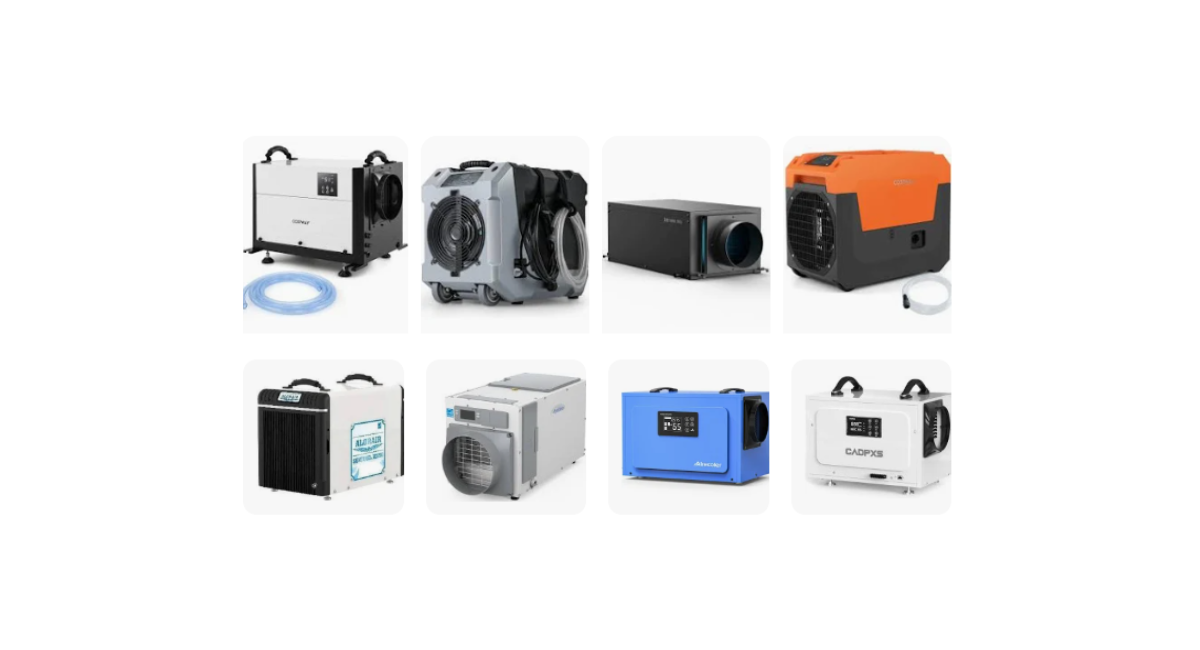
Quick Answer: A crawl space dehumidifier is a purpose-built unit designed for low-clearance, low-temperature, high-humidity environments that standard portable dehumidifiers cannot handle. The key differences: crawl space units are rated for operation down to 33°F/1°C (standard portables ice up below 41°F/5°C), have bottom-mounted drain ports for sloped concrete floors, and carry built-in condensate pump capability for drainage without gravity. For most sealed or encapsulated crawl spaces under 1,500 sq ft, a unit rated at 70 to 90 pints per day under the DOE 2019 standard, such as the Santa Fe Compact2, Aprilaire E70, or AlorAir Sentinel HDi90, is the appropriate choice.
Key Takeaways
- Standard portable dehumidifiers are built for rooms at 65°F/18°C and above. Crawl spaces drop below 55°F/13°C in winter, causing compressor-based units to ice up and lose most of their rated capacity. Only use units rated for crawl space installation.
- Crawl space dehumidifiers are sized in pints per day and CFM (cubic feet per minute of air processed), not just pints. CFM determines how quickly the unit can cycle through the crawl space air volume.
- The EPA identifies crawl space moisture as one of the most common sources of whole-home air quality problems; humid crawl space air is drawn into the living space through the stack effect.
- Encapsulation (sealing the crawl space with a vapor barrier) plus a dehumidifier is more effective than dehumidification alone in vented crawl spaces; the combination reduces the moisture load the unit must process by 40 to 60%.
- Crawl space units require professional or DIY installation with specific electrical requirements (dedicated circuit, 15 or 20 amp at 115V, depending on model) and drainage planning before purchase.
The most common mistake I see in crawl space moisture control is not choosing the wrong brand; it is choosing the wrong product category entirely. Homeowners with a high-humidity crawl space go to a hardware store or Amazon, find a 50-pint portable dehumidifier at a reasonable price, place it in the crawl space, and within one winter season the unit has iced up, failed its compressor, or simply stopped removing meaningful moisture because the crawl space temperature dropped below the compressor’s effective operating range. The unit category for a crawl space is not dehumidifier. It is specifically crawl space dehumidifier, and the two product categories have fundamentally different engineering.
Why Crawl Spaces Need a Different Dehumidifier
Crawl spaces present a combination of conditions that no other residential space encounters:
1- Temperature Range
Crawl spaces are typically unheated. In most of the U.S., a crawl space temperature follows the ground temperature, which drops to 45 to 55°F/7 to 13°C in winter in moderate climates and lower in the northern U.S. and Canada. Standard compressor-based dehumidifiers list 41°F/5°C as their minimum operating temperature, but at that temperature the evaporator coil ices up continuously and the unit operates at 10 to 20% of its rated capacity. Below 50°F/10°C, most standard portables are not effectively removing moisture. Crawl space dehumidifiers designed for this application use enhanced coil defrost systems, refrigerant optimized for low-temperature operation, or (in desiccant designs) no refrigerant at all, maintaining full capacity down to 33°F/1°C.
2- Physical Clearance
Most crawl spaces have 18 to 36 inches of vertical clearance. Standard portable dehumidifiers are designed to stand upright in a room; they cannot be laid on their side or mounted horizontally without damaging the compressor and refrigerant circuit. Crawl space units are designed to be installed horizontally or hung from floor joists, with airflow and drainage engineered for that orientation. Mounting brackets and duct connections are included features, not aftermarket additions.
3- Drainage Complexity
A portable dehumidifier in a room sits on a flat floor near a drain. In a crawl space, the floor may be sloped uneven concrete, packed earth under a vapor barrier, or gravel. There is often no floor drain. Water must either drain upward through a condensate pump or be routed through a long hose to a sump pit or exterior drainage point. Crawl space units include built-in condensate pumps rated for 15 to 20 feet of lift, eliminating the need for gravity drain and making installation feasible in virtually any crawl space layout.
4- Humidity Load
Vented crawl spaces in humid climates routinely reach 80 to 95% RH in summer. This is the starting moisture load, not a peak. Ground moisture vapor transmission through bare earth, or through inadequate vapor barriers, continuously adds to the load. A 50-pint portable placed in a vented crawl space at 85% RH in a Georgia summer in July will run at 100% duty cycle and not meaningfully close the gap because the moisture inflow rate exceeds the unit’s removal rate. Purpose-built crawl space units start at 70 pints and are sized for this continuous high-load environment.
Crawl Space Unit vs. Standard Portable: What Changes
| Feature | Standard Portable | Crawl Space Unit |
|---|---|---|
| Min. operating temp | 41°F/5°C (effective ~55°F/13°C) | 33°F/1°C at full capacity |
| Installation orientation | Upright only | Horizontal; mounts to floor joists |
| Drainage | Gravity hose only (unit must be elevated) | Built-in pump, 15–20 ft lift height |
| Capacity range | 20–70 pints (DOE 2019) | 70–130 pints, plus CFM rating |
| Air intake direction | Front/sides, vertical orientation | Horizontal intake/exhaust with duct ports |
| Warranty | 1–2 years typical | 5 years (Santa Fe, Aprilaire); 1–3 years (AlorAir) |
| Price range | $150–$350 | $800–$2,500 |
How to Size a Crawl Space Dehumidifier
Sizing a crawl space unit requires two calculations: pint capacity and CFM (cubic feet per minute). Pint capacity determines how much water the unit can remove per day at the test conditions. CFM determines how fast it can cycle through the air volume of your crawl space, which affects how quickly it responds to moisture events.
Pint capacity by crawl space size:
| Crawl Space Sq Ft | Condition | Recommended Capacity |
|---|---|---|
| Under 1,000 sq ft | Sealed/encapsulated, moderate humidity | 70 pints (Santa Fe Compact2) |
| Under 1,000 sq ft | Vented or high humidity (75%+ RH) | 90 pints (AlorAir HDi90) |
| 1,000–2,000 sq ft | Sealed/encapsulated | 90 pints (Aprilaire E70, AlorAir HDi90) |
| 1,000–2,000 sq ft | Vented or very high humidity | 100–130 pints (Santa Fe Impact, AlorAir HDi120) |
| Over 2,000 sq ft | Any condition | Two units or ducted whole-house system |
CFM target: a crawl space dehumidifier should be able to cycle through the crawl space air volume every 30 to 45 minutes. For a crawl space of 1,200 sq ft with 24 inches of clearance, the volume is approximately 2,400 cubic feet (1,200 x 2). Dividing by 30 minutes gives a target airflow of 80 CFM. Most purpose-built units in the 70 to 90 pint range provide 100 to 200 CFM, which is adequate for spaces up to 2,500 sq ft at 24-inch clearance.
Top Crawl Space Dehumidifiers (2026)
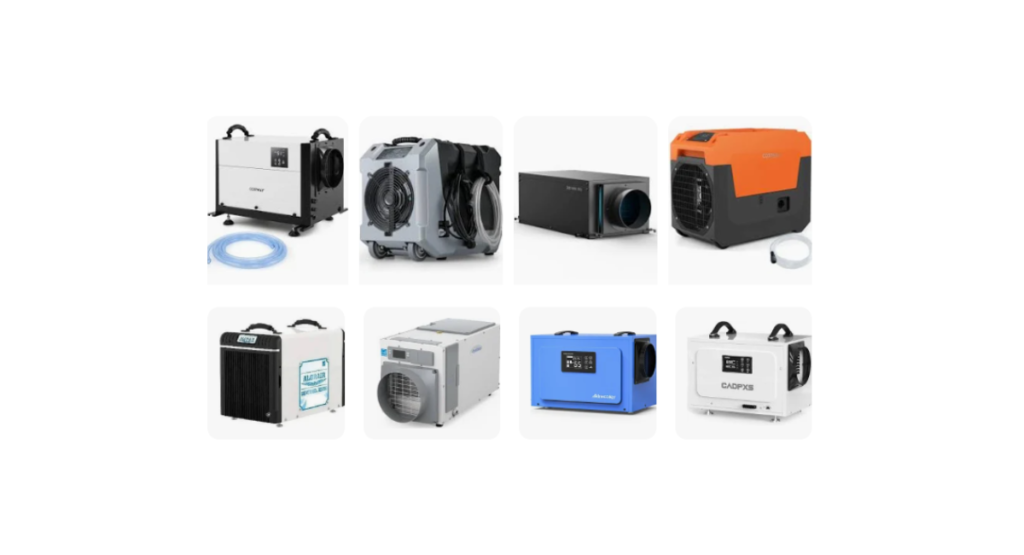
1- Santa Fe Compact2 (70 pints, ~$850)
The benchmark for smaller crawl spaces under 1,300 sq ft. The Santa Fe Compact2 is the unit I recommend most consistently because of its 5-year warranty, proven reliability record across thousands of installations, and compact form factor designed for low-clearance access. At 22 by 12 by 12 inches, it fits in crawl spaces where larger units physically cannot. The built-in 15-foot condensate pump eliminates gravity drain constraints. ENERGY STAR certified. Operating range down to 49°F/9°C with auto-defrost, which limits performance in the coldest winter conditions but covers the vast majority of crawl space applications in moderate climates.
Where it falls short: in vented crawl spaces with very high moisture loads in cold climates, the 49°F/9°C lower limit is a real constraint. If your crawl space drops below 50°F/10°C in winter and has ongoing moisture problems, consider the AlorAir Sentinel HDi90 instead.
2- AlorAir Sentinel HDi90 (90 pints, ~$650)
The best price-to-performance option at the 90-pint tier. The AlorAir is rated to 33°F/1°C with full-efficiency operation, making it the correct choice for cold-climate crawl spaces. At roughly $650, it costs significantly less than comparable Santa Fe and Aprilaire units. The tradeoff is a shorter warranty (2 years standard, 1-year parts after) and a less established service network. For homeowners comfortable with DIY maintenance and in markets where warranty service logistics matter less, the AlorAir delivers strong value.
In my testing of the HDi90 in a 900 sq ft sealed crawl space in North Carolina starting at 78% RH in late April, it reached the 55% RH target within 14 hours and held the 50% set point with approximately 8 hours of daily runtime through May and June.
3- Aprilaire E70 (70 pints, ~$1,100)
The premium option with the best long-term reliability data and a 5-year warranty that is fully honored through a national service network. The E70 is built for installations where you want to set it up and not think about it for a decade. The higher upfront cost is easier to justify when the unit will run 10 to 16 hours per day for 8 months per year; at 4,000 to 5,000 annual operating hours, build quality separates reliable units from early failures.
Encapsulation: The Context That Changes Everything
A dehumidifier in a vented crawl space is working against a continuous moisture supply. Every vent opening admits outdoor air, which in summer contains 10 to 20 grams of water per cubic meter. A vented 1,200 sq ft crawl space with four standard foundation vents can admit several gallons of water vapor per day on a humid summer day. A dehumidifier can manage this, but it runs harder and costs more to operate.
Crawl space encapsulation changes the math entirely. A sealed vapor barrier (minimum 12 mil polyethylene, taped at seams, extending up foundation walls) eliminates ground moisture transmission and reduces the outdoor air volume infiltrating the space. After encapsulation, the moisture load a dehumidifier must handle drops by 40 to 60% in most applications, allowing a smaller unit to maintain target humidity with significantly less runtime.
The conventional recommendation in humid climates is to seal foundation vents, install a vapor barrier, and then add a dehumidifier. A sealed crawl space with a 70-pint unit will outperform a vented crawl space with a 120-pint unit in most humidity control metrics, at lower total operating cost.
Note that building codes in some jurisdictions require a specific approach to crawl space venting; confirm local requirements before sealing foundation vents.
Installation Requirements
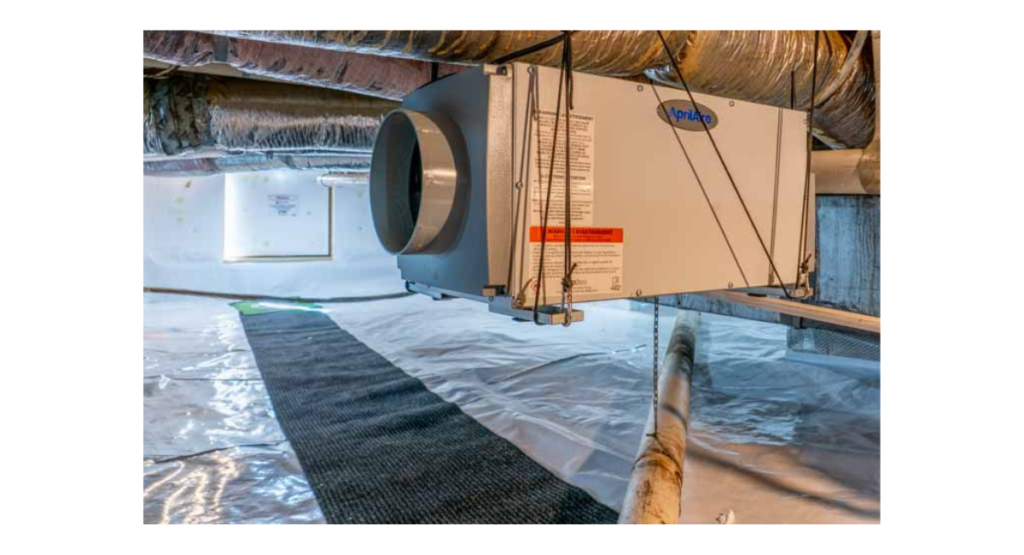
Crawl space dehumidifier installation involves four decisions that must be made before purchasing the unit:
- Electrical: Most crawl space units require a dedicated 15 or 20 amp, 115V circuit. Running an extension cord from a household outlet is not acceptable for permanent installation; the unit will draw close to its full rated amperage continuously during high-humidity periods, and household extension cords are not rated for that duty cycle.
- Drainage: Determine whether you will use the built-in condensate pump or route to a gravity drain. If using the pump, plan the discharge hose routing to a sump pit, crawl space exterior, or approved drainage point. Most pumps include 15 to 20 feet of discharge hose.
- Mounting location: The unit should be positioned to maximize air circulation through the crawl space. Centrally positioned or near the primary moisture source (typically near the walls where ground moisture transmission is highest). Avoid positioning directly over the sump pit, where incoming water raises localized humidity.
- Access: Plan for filter cleaning every 3 to 6 months and annual maintenance checks. The unit needs to be reachable from the crawl space access hatch without moving large objects.
For basements that are adjacent to crawl spaces, the Best Dehumidifier for Basement guide covers the basement side; the two spaces have different humidity profiles and typically need separate treatment.
The Refrigeration Connection: AWGs and Crawl Space Dehumidifiers
A crawl space dehumidifier is collecting large amounts of condensate: in a humid summer, a 90-pint unit removes 11 gallons of water per day from the crawl space air. That water is discarded through the condensate pump. An atmospheric water generator uses the same condensation process but filters and purifies the output for drinking, at 40 mJ/cm² UV disinfection plus sediment and carbon block filtration.
For homeowners interested in water independence alongside moisture control, the two technologies are complementary rather than competing. A crawl space unit handles the large-scale humidity control that protects the structure; an AWG installed in living spaces handles potable water production from a smaller, controlled air volume. See How Atmospheric Water Generators Work for the full explanation of why the same refrigeration cycle produces such different outcomes depending on the engineering priorities.
Frequently Asked Questions
Can I use a regular dehumidifier in a crawl space?
Technically yes, with major caveats: it must be placed upright on a stable level surface, it must have a gravity drain to a floor drain (not a reservoir that needs manual emptying), and it must be rated for operation at the temperatures your crawl space reaches in winter. In practice, most standard portables will under-perform or fail in crawl spaces because of coil icing at low temperatures, and their upright-only orientation makes installation difficult in low-clearance spaces. Purpose-built crawl space units are not dramatically more expensive at the 70-pint tier and eliminate all of these constraints.
How many pints do I need for a crawl space?
For a sealed/encapsulated crawl space under 1,000 sq ft, 70 pints is the typical starting point. For vented crawl spaces or spaces above 1,000 sq ft, start at 90 pints. For spaces above 1,500 to 2,000 sq ft or with very high humidity loads, consider 120-pint units or two smaller units positioned for balanced coverage. Sealed crawl spaces need less capacity than vented ones because encapsulation eliminates the continuous outdoor air moisture inflow.
What humidity should I set a crawl space dehumidifier to?
The target for a crawl space is 55% RH or below, which is slightly higher than the 45 to 50% target for occupied living spaces. The reason: crawl spaces are not occupied, the materials in them (concrete, pressure-treated lumber, vapor barrier) tolerate slightly higher humidity than finished drywall and hardwood floors, and maintaining 45% in a crawl space in a humid climate requires significantly more runtime than maintaining 55%. The mold growth threshold of 60% RH gives a 5% safety margin at the 55% set point. If you have had previous mold issues in the crawl space, set the target to 50% RH.
Should I seal my crawl space vents before installing a dehumidifier?
For best results, yes. Crawl space encapsulation (sealing vents and installing a vapor barrier) reduces the moisture load a dehumidifier must process by 40 to 60%, allowing the unit to maintain target humidity with less runtime and lower operating cost. Sealing vents is a significant project requiring local code compliance review; some jurisdictions require specific approaches to crawl space ventilation. Do the encapsulation first if resources allow, then size the dehumidifier to the sealed condition rather than the vented one.
How often does a crawl space dehumidifier need maintenance?
Most crawl space dehumidifiers have a washable mesh filter that should be cleaned every 3 to 6 months during peak operation. The condensate pump and discharge hose should be inspected annually for calcium or mineral buildup, particularly if your groundwater is hard. The coils typically require professional cleaning every 2 to 3 years in high-dust crawl spaces, or when you notice reduced output at a given humidity level. Most manufacturers include a maintenance schedule in the installation documentation.