
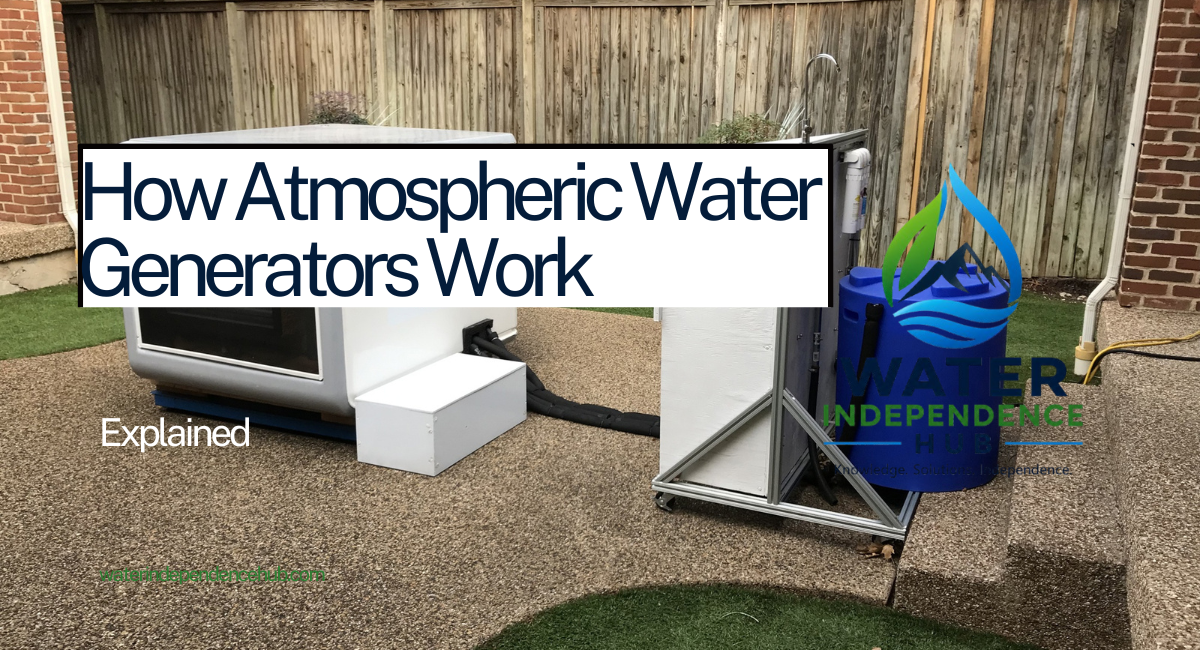
Quick Answer: An atmospheric water generator condenses water vapor from ambient air using a refrigeration cycle, the same physics as your air conditioner, then filters and disinfects that condensate to produce drinking water. Warm humid air contacts a cold evaporator coil, water vapor condenses into liquid droplets, and the collected water passes through a sediment pre-filter, activated carbon block, and UV disinfection chamber at 40 mJ/cm² before reaching the storage tank. The result is potable water that meets EPA drinking water standards for biological contamination, produced entirely from air. Output ranges from 3 to 10 gallons per day in residential units at typical conditions of 65°F/18°C and 60% RH or above.
Key Takeaways
- The condensation mechanism in an AWG is identical to the one in a dehumidifier or an air conditioner. What makes an AWG different is everything that happens to the water after it condenses: filtration, UV treatment, and a sealed food-grade collection path.
- Ambient humidity is the primary constraint on output. Below 45% RH, most residential AWGs produce water at a fraction of their rated capacity. Above 70% RH, they approach their rated maximum.
- Temperature matters as much as humidity. AWGs produce more water at 80°F/27°C than at 65°F/18°C at identical relative humidity, because warmer air holds more water vapor per cubic meter.
- The filtration stack is the engineering that justifies the price premium over a dehumidifier. Remove it, and you have a dehumidifier with a pipe. The UV stage at 40 mJ/cm² is non-negotiable for biological safety.
- Electricity consumption is real and consistent: most residential AWGs draw 300 to 800 watts continuously when running. At 10 cents per kWh, a unit producing 5 gallons per day costs roughly $0.50 to $1.20 per day to operate. That cost is often underestimated by buyers focused only on the purchase price.
Every explanation of atmospheric water generators I have read starts with the same line: they harvest moisture from the air. Technically accurate. Also the least useful thing you can know about how these machines work, because it tells you nothing about why they cost $2,000 instead of $200, why they produce 5 gallons in Florida and 1 gallon in Nevada, or whether the water coming out of them is actually safe to drink.
I have spent the better part of 15 years evaluating residential water systems, and AWGs are the product category where I see the most confusion between the marketing story and the engineering reality. The marketing story is elegant: plug it in, drink the sky. The engineering reality is more interesting and, once you understand it, makes you a much smarter buyer or a much more realistic skeptic depending on where you live.
This is the explanation I wish I had found when I first started researching this category.
The Physics, Without the Marketing Layer
The air around you contains water. Not as a mystery or a metaphor as actual water molecules in vapor form, mixed with the nitrogen and oxygen you breathe. At 70% relative humidity (RH) and 75°F/24°C, a cubic meter of air contains roughly 15 grams of water vapor. Scale that up to the volume of a living room, and there are several gallons of water suspended in the air at any given moment.
To extract that water, you need to cool the air below what is called the dew point the temperature at which water vapor starts condensing into liquid. If the air is at 75°F/24°C and 70% RH, the dew point is roughly 62°F/17°C. Drop the air temperature below that threshold, and the vapor has to go somewhere. It becomes liquid water on whatever cold surface it contacts.
You have seen this happen dozens of times. It is what happens on the outside of a cold glass of water on a humid summer day. It is what happens inside your air conditioner, which is why AC units produce condensate that drains to the outside. It is exactly what happens inside a dehumidifier. The physics are the same across all three. What changes is what you do with the water once you have collected it.
An AWG cools air below the dew point using a vapor-compression refrigeration cycle: a compressor pressurizes refrigerant gas, which releases heat as it condenses in the condenser coil, then absorbs heat as it evaporates in the evaporator coil, making that coil cold. Warm room air is pulled across the cold evaporator coil by a fan, water vapor condenses on the coil surface, and liquid water drips into a collection area. The refrigerant cycles continuously, the coil stays cold, and the collection continues as long as there is humidity in the air and power to the compressor.
That is the entire physical mechanism. Nothing exotic. The same process that keeps your food cold in the refrigerator is producing your drinking water.
The Four Stages of Water Production
Understanding the production stages matters because each stage is a potential failure point and a design decision that separates a well-engineered unit from a cheap one. When evaluating any AWG, I look at how each of these four stages is handled before I look at anything else.
Stage 1: Air Intake and Pre-Filtration
Before air reaches the evaporator coil, it passes through an intake filter. In a dehumidifier, this is a basic mesh screen designed to keep the coil clear of large dust particles — it is a maintenance filter, not a water quality filter. In a properly engineered AWG, the intake filtration has a different job: keeping the condensate clean before it forms. Air carries mold spores, bacteria, dust mite particulate, VOCs, and in some environments, industrial pollutants. If contaminated air contacts the evaporator coil directly, some of those contaminants end up in the condensate.
Higher-end residential AWGs use a washable pre-filter followed by a HEPA-grade or equivalent secondary filter before the air reaches the coil. This is not standard across the category. Cheaper units often use the same mesh screen a dehumidifier uses, and rely entirely on post-collection filtration to compensate. That is a weaker design, and buyers should know the difference.
Stage 2: Condensation and Collection
Water condenses on the evaporator coil surface and drips into the collection area. In a dehumidifier, that collection area is an open plastic reservoir — not food-grade certified, exposed to ambient air, and a known site for mold and bacterial colonization if not cleaned regularly. In an AWG, the condensate path from coil to storage tank is sealed and manufactured from food-grade certified materials. The water does not contact ambient air after condensation. This sealed path is not cosmetic: it is the design feature that keeps post-condensation contamination from reversing the work the intake filtration just did.
The evaporator coil itself is typically aluminum fins bonded to copper tubing. Both metals can leach trace amounts into condensate over time, particularly as the coil oxidizes. A well-maintained AWG addresses this through the post-collection filtration stage. A unit with inadequate post-filtration that also has a corroding coil is producing water with metal contamination that the collection stage cannot catch.
Stage 3: Filtration
This is where most of the engineering that separates AWGs from dehumidifiers lives. The condensate passes through a treatment stack before it reaches the storage tank or the tap. A complete stack on a quality residential unit includes: a sediment pre-filter (typically rated to 5 µm) that removes particulate, an activated carbon block that adsorbs volatile organic compounds, residual coil-contact metals, chlorine if any is present, and taste/odor compounds, and a UV disinfection chamber.
The UV stage is the one I watch most closely. The standard for effective disinfection is a UV dose of 40 mJ/cm² — the same dose used in municipal water treatment systems and validated by the EPA’s drinking water standards to eliminate bacterial and viral contamination at 99.99% or better efficacy. Units that list a UV lamp without specifying the dose, or that list doses below 30 mJ/cm², are not meeting that standard. I have seen AWG marketing materials that mention UV as a feature without disclosing the dose at all, which tells you something about what the dose actually is.
Some units add a post-UV activated carbon polish and a remineralization cartridge. The remineralization stage addresses a real issue: condensation is inherently a de-mineralization process, because only water molecules move into vapor form — minerals stay behind. AWG output starts at 0 to 5 ppm TDS (total dissolved solids), which is lower than most people find palatable and lower than the trace minerals your body benefits from in drinking water. Adding back calcium and magnesium at controlled concentrations produces water that tastes better and carries minor nutritional value. Whether you need this stage depends on whether you also use AWG water for cooking, which I think most people eventually do.
Stage 4: Storage and Dispensing
Collected water goes into a sealed food-grade storage tank, typically 1 to 5 gallons on residential units. A secondary UV lamp in the tank (often called a “keep-fresh” cycle) runs periodically to maintain disinfection in stored water and prevent biological growth during periods of low draw. On units without this feature, water sitting in the tank for more than 24 hours can begin accumulating bacterial contamination even if the initial filtration was complete. For households drawing water consistently throughout the day, this matters less. For vacation or intermittent use scenarios, it matters significantly.
For the builders reading this: Curious about what it actually takes to build an Atmospheric Water Generator?
There’s a documented DIY blueprint for a household-scale atmospheric water generator: parts list, wiring, the cooling-stage design, and the filter stack that makes the water actually drinkable. Most readers finish the build in one or two weekends. Worth a look before deciding if it’s a fit for you.
The Filtration Stack: Why This Is Not Just a Dehumidifier With a Pipe
I want to address this comparison directly because it comes up constantly. People look at an AWG, notice that it uses the same refrigeration cycle as a dehumidifier, and conclude that they could achieve the same result by attaching a filtration system to their basement dehumidifier. The engineering argument against this is more specific than “it won’t work.”
A dehumidifier is designed to remove moisture from air as efficiently as possible, measured in pints per day and evaluated against the DOE 2019 test standard. The intake air is unfiltered (mesh only), the condensate path is open to ambient air, the reservoir is not food-grade certified, and there is no UV treatment. To retrofit food-grade potability onto a dehumidifier, you would need to replace the intake housing with a HEPA-grade filter assembly, replace the reservoir with a sealed food-grade container, add a sediment filter, an activated carbon block, and a UV chamber downstream of the condensate collection point, and certify the entire assembly. The modification cost exceeds the cost of a purpose-built AWG, without the food-grade certification the AWG carries from the factory.
I explored this question in detail in a separate piece on whether dehumidifier condensate is drinkable, if you want the full analysis. The short version: the physics are shared; the engineering for potability is not. For a direct side-by-side breakdown of where AWGs and dehumidifiers actually diverge, see AWG vs Dehumidifier: Same Technology, Different Mission.
What Your Environment Does to Daily Output
This is the section where I am most critical of how AWGs are marketed, because the gap between rated output and realistic output can be significant — and it depends almost entirely on where you live and where in your home the unit sits.
Manufacturers rate AWG output at standardized conditions: typically 80°F/27°C and 80% RH. These are conditions that exist in a Florida summer, or in a server room, or in a greenhouse. They do not exist in most American homes or offices. At 70°F/21°C and 60% RH, a unit rated at 10 gallons per day at 80°F/80% RH will typically produce 4 to 6 gallons per day. At 65°F/18°C and 50% RH, output drops further, to 2 to 3 gallons per day on many units.
Two variables drive this: absolute humidity and temperature. Relative humidity tells you what percentage of the air’s capacity for water vapor is filled. Absolute humidity tells you how many grams of water vapor are actually present per cubic meter of air. At 60% RH and 65°F/18°C, there are roughly 8 grams of water vapor per cubic meter of air. At 60% RH and 85°F/29°C, there are roughly 20 grams per cubic meter — 2.5 times as much water available for condensation at identical relative humidity. This is why temperature matters as much as RH, and why AWG marketing that quotes only RH requirements is incomplete.
Placement within the home matters for the same reason. An AWG placed in an air-conditioned 68°F/20°C living room produces less water than the same unit placed in an unconditioned 85°F/29°C garage or utility room in summer. The tradeoff is that you would not typically want to store your water appliance where you cannot comfortably access it and maintain it. This is a real tension in optimizing AWG placement, and one that rarely appears in product marketing.
For anyone in a dry climate — the American Southwest, high desert, parts of the intermountain West — AWGs are a harder sell at honest output numbers. Below 40% RH, most refrigerant-cycle AWGs produce water at such a low rate that the cost per gallon becomes economically impractical. There are alternative AWG technologies (desiccant-based systems) designed for low-humidity environments, but they are not the same product category as the residential refrigerant AWG, they are significantly more expensive, and they operate at much lower production rates.
Energy Consumption: The Number Most Buyers Get Wrong
AWGs are compressor-based appliances. That means they draw significant continuous power when running. A residential unit producing 3 to 8 gallons per day typically consumes 300 to 800 watts continuously during operation cycles. At a U.S. average electricity rate of roughly 12 cents per kWh, a unit running 16 hours per day at 500 watts costs about $0.96 per day, or roughly $29 per month, to operate.
At 5 gallons of production per day, that works out to approximately 19 cents per gallon in electricity cost alone — before factoring in filter replacement (sediment and carbon block filters typically run $20 to $40 per replacement, with replacement intervals of 6 to 12 months), UV lamp replacement (annually on most units), and the amortized purchase cost of the machine itself. All-in, residential AWG water typically costs $0.30 to $0.60 per gallon when you account for operating expenses properly. That is more expensive than filtered tap water (fractions of a cent per gallon) but less expensive than delivered bottled water ($1.00 to $1.50 per gallon at retail), which is the more honest comparison for the households actually buying AWGs.
I cover the full financial model, including break-even analysis against various water supply alternatives, in the Are AWGs Worth It? piece. The unit economics work well under certain conditions and poorly under others; the details matter more than the headline number.
ENERGY STAR certification is available for AWGs and is worth looking for. Certified units are tested against the agency’s water efficiency standards, which include an Integrated Energy Factor (IEF) measurement — essentially liters of water produced per kWh consumed. A higher IEF means more water per unit of electricity. Not all AWGs on the market are ENERGY STAR certified, and uncertified units from budget manufacturers can have IEF scores significantly below the category average.
For the builders reading this: Curious about what it actually takes to build an Atmospheric Water Generator?
There’s a documented DIY blueprint for a household-scale atmospheric water generator: parts list, wiring, the cooling-stage design, and the filter stack that makes the water actually drinkable. Most readers finish the build in one or two weekends. Worth a look before deciding if it’s a fit for you.
What AWG Water Actually Tastes Like
I have tested AWG output from several units, and the honest answer is: it depends entirely on whether the unit includes a remineralization stage.
Without remineralization, AWG water is essentially ultra-pure water with a TDS of 0 to 5 ppm. Some people find this pleasant — it is clean, without the mineral aftertaste of hard tap water or the slight chlorine note of most municipal supply. Others find it flat or empty-tasting, which is a reasonable description of water with no dissolved solids. It is the same phenomenon as drinking distilled water: chemically correct, not necessarily enjoyable.
With a remineralization cartridge, the unit adds back calcium and magnesium at controlled concentrations, typically bringing TDS up to 30 to 80 ppm. That range produces water that most people describe as clean and slightly mineral — similar to a light spring water. At this range, the water is also appropriate for coffee and tea brewing, where TDS between 50 and 150 ppm is generally considered optimal by the Specialty Coffee Association and similar authorities.
One note I always make: the taste profile of AWG water reflects the environment the unit is operating in. A unit placed in a space with VOC exposure (fresh paint, adhesives, off-gassing furniture, cleaning products) will produce water with a slightly chemical note even after carbon filtration, because activated carbon has a finite adsorption capacity. Units drawing from clean indoor air in well-ventilated spaces taste noticeably better than identical units in enclosed spaces with ongoing chemical exposure. Placement is not just a volume optimization question — it is a quality question.
Who This Makes Practical Sense For
After fifteen years of following this category, my honest position is that AWGs are not a universal solution. They are an excellent fit for a specific set of circumstances, and a frustrating fit outside of it.
AWGs make clear practical sense for households in humid climates (above 60% average RH through most of the year) where municipal water quality is poor or where grid-independent water supply is a genuine priority. The Gulf Coast, Southeast US, Hawaii, coastal areas generally — these environments produce AWG output close to rated specifications without optimization. Paired with a reasonable expectation of electricity cost and consistent filter maintenance, an AWG in these conditions is a defensible primary or supplemental water source.
AWGs also make sense for off-grid applications where the alternative is trucked-in water or collected rainwater requiring equivalent treatment. The physics of AWG water production are more consistent than rainfall, and the unit’s self-contained treatment stack is simpler to maintain than a multi-component rainwater collection and filtration system. I have looked at several off-grid setups where an AWG paired with a modest solar array delivers a more reliable water source than anything else available at the location.
Where AWGs make less sense: in well-supplied municipal water areas with good tap water quality, in dry climates without supplemental humidity management, and for buyers whose primary motivation is cost reduction rather than independence. On pure cost-per-gallon, filtered tap water wins decisively. An AWG purchase that is motivated by economics rather than independence or resilience is likely to disappoint.
If you are evaluating specific units, the Residential AWG Buyer’s Guide covers the major models with honest capacity estimates at realistic conditions. For the home buyer’s perspective focused on whole-home integration, the AWG for Home piece works through the installation and sizing questions. If you are thinking about building rather than buying, the DIY AWG guide covers the component and assembly reality at the bench-build level. And if price is the primary variable you are working with, the AWG price guide gives a realistic breakdown across the residential, semi-commercial, and commercial tiers with honest cost-per-gallon modeling.
The Smart Water Box review is the most detailed single-product analysis I have written in this category, if you want to see what a real-conditions evaluation looks like before committing to any unit.
All of our AWG coverage, including buyer guides, technical explainers, and climate-specific analysis, lives in the Atmospheric Water Generators category.
For the builders reading this: Curious about what it actually takes to build an Atmospheric Water Generator?
There’s a documented DIY blueprint for a household-scale atmospheric water generator: parts list, wiring, the cooling-stage design, and the filter stack that makes the water actually drinkable. Most readers finish the build in one or two weekends. Worth a look before deciding if it’s a fit for you.
Frequently Asked Questions
How much water does an atmospheric water generator produce per day?
At manufacturer test conditions of 80°F/27°C and 80% RH, residential units typically produce 3 to 10 gallons per day. At more typical indoor conditions of 70°F/21°C and 60% RH, expect 40 to 60% of rated output from most units — meaning a unit rated at 8 gallons per day will realistically produce 3 to 5 gallons in a standard air-conditioned home in a moderately humid climate. Output climbs meaningfully in naturally hot and humid environments: a unit placed in an unconditioned space in coastal Georgia in August will produce significantly more than the same unit in a climate-controlled Phoenix office in January.
Is AWG water safe to drink without additional filtration?
Water from an AWG with a complete treatment stack — sediment pre-filter rated to 5 µm or better, activated carbon block, and UV disinfection at 40 mJ/cm² minimum — meets EPA drinking water standards for biological contamination in normal operating conditions. The key qualifier is “normal operating conditions,” which means the filters are current, the UV lamp is functioning, and the unit is placed in clean indoor air rather than a space with significant chemical off-gassing. A unit with expired filters or a failed UV lamp does not provide the same safety guarantee. Manufacturer maintenance schedules exist for this reason and should be followed rather than estimated.
How much electricity does an atmospheric water generator use?
Residential AWGs typically draw 300 to 800 watts continuously when the compressor is running. Units cycle on and off based on water demand and tank level rather than running at full duty cycle 24 hours a day, so actual energy consumption per day depends on how much water you draw. At typical household consumption of 3 to 5 gallons per day, most units run 12 to 18 hours per day, consuming roughly 4 to 12 kWh. At the U.S. average electricity rate of approximately 12 cents per kWh, operating cost is $0.50 to $1.50 per day. Over a year, that is $180 to $550 in electricity, which should be a real line item in any honest cost analysis.
What is the minimum humidity an AWG needs to function?
Most refrigerant-cycle residential AWGs require 45 to 50% RH at a minimum to produce water at a meaningful rate. Below 40% RH, water production falls to a trickle — fractions of a gallon per day — because there is simply not enough water vapor in the air to condense at practical rates given the unit’s airflow and coil surface area. This is the fundamental constraint that makes AWGs poorly suited to dry climates without supplemental humidification. The dew point at 40% RH and 70°F/21°C is approximately 45°F/7°C — the coil would need to stay below that temperature continuously, which requires more energy and still produces very little water. At 60% RH and the same ambient temperature, the dew point rises to approximately 53°F/12°C, which is a much more manageable operating condition.
How often do AWG filters need to be replaced?
Sediment pre-filters typically need replacement every 3 to 6 months under normal operating conditions. Activated carbon blocks last 6 to 12 months, depending on the VOC load in the intake air and the volume of water produced. UV lamps generally require annual replacement, as UV output degrades with hours of operation even when the lamp still illuminates. Remineralization cartridges (on units that include them) follow manufacturer-specific schedules based on water production volume, typically 500 to 1,000 gallons per cartridge. Running any filter past its replacement interval is not a trivial cost-cutting measure: an exhausted carbon block provides no adsorption protection, and a degraded UV lamp provides no disinfection. Both failures produce water that appears normal but may not be safe.
Leave a Reply