
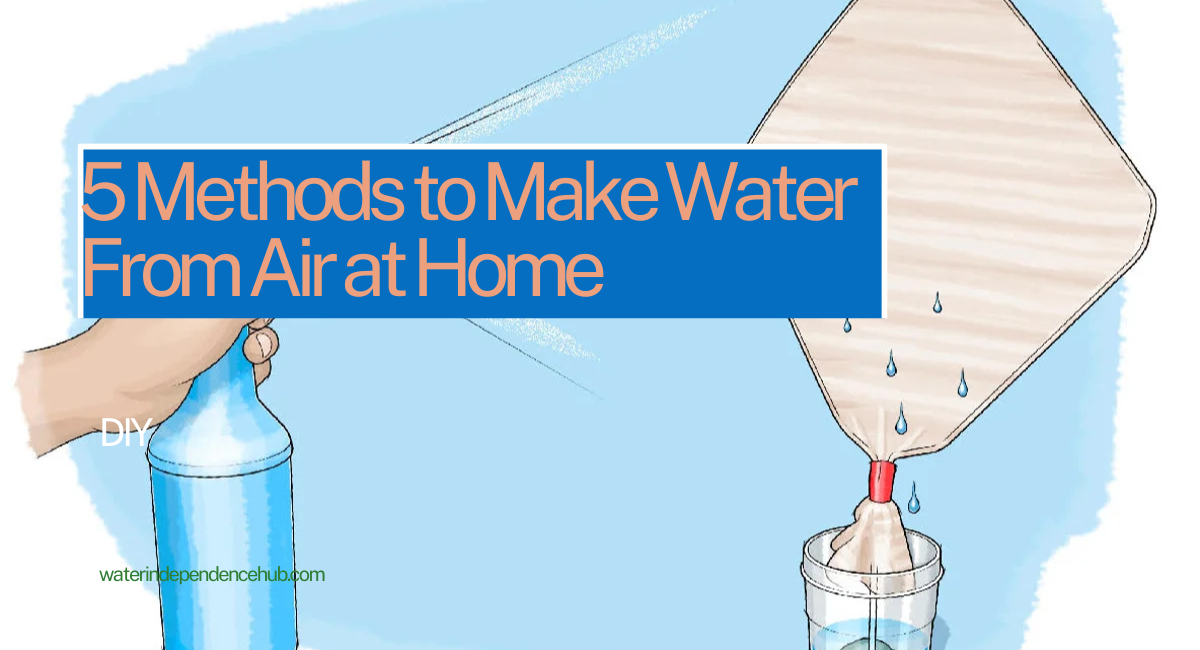
The tap goes dry. The bottled water in your garage runs out by day three. And somewhere in the air around you — right now, in your kitchen, in your backyard — there are gallons of clean, drinkable water just hanging there.
That isn’t a metaphor. The atmosphere holds an estimated 12,900 cubic kilometers of water at any given moment. The question was never whether the water is there. The question is whether you know how to pull it out.
This guide walks through five practical ways to make water from air at home — from a cheap trick most people overlook to the actual system used in modern off-grid setups. Some are basic survival hacks. One can quietly cover an entire household. By the end, you’ll know which one fits your situation, your budget, and how serious you are about being water-independent. If you want the bigger picture first, our complete guide to water from air is the right starting point.
Key Takeaways
- The air in a typical home holds enough water vapor to supply a household — if you know how to extract it.
- A standard dehumidifier produces 2–5 gallons of drinkable water per day once filtered.
- Solar stills and plant transpiration bags work off-grid but yield less than a quart per day.
- Atmospheric water generators are the only method that scales to real water independence (5–30+ gallons/day).
- All water-from-air methods need basic filtration before drinking.
Why the Air Around You Already Holds Gallons of Water
Air is rarely “dry” in the way most people imagine. Even in a desert, the air is carrying water vapor — usually somewhere between 10% and 90% relative humidity, depending on temperature and location. A typical American living room at 70°F and 50% humidity contains roughly half a glass of water in vapor form, just floating around the room.
Scale that up to an entire neighborhood, and the numbers get strange fast. The air sitting above one acre of land on a humid summer day can hold thousands of gallons of water. The science is simple: warm air holds more moisture, and when you cool that air below its dew point, the water has to go somewhere. It condenses onto whatever cool surface is nearby — your bathroom mirror after a shower is the same physics, just smaller.
Every method below is just a different way of forcing that condensation to happen on purpose, in a place you can collect it.
Method 1 — The DIY Dehumidifier Trick
This is the cheapest, most beginner-friendly entry point. A standard household dehumidifier already does what you want. It pulls in warm air, runs it across cold coils, and collects the condensed water in a tank. People empty that tank into the sink every day without thinking about it. You can drink it instead — once it’s filtered.
A mid-range dehumidifier costs $80 to $200 and produces between 2 and 5 gallons of water per day in a typical climate. The downsides: it needs grid electricity, it’s loud, and the water picks up traces of dust and whatever has been growing on the coils. Run it through a basic carbon filter and it’s drinkable.
It’s not independence. But it’s proof of concept, and a working backup if the supply ever stops.
Method 2 — The Solar Still (Passive and Off-Grid)
A solar still uses heat from the sun and a transparent surface to do the same job a dehumidifier does, with no electricity. The classic version: dig a shallow pit, place a cup in the center, lay clear plastic across the top with a small stone in the middle so the plastic sags toward the cup. The sun heats the moist soil, water vapor rises, hits the cool underside of the plastic, condenses, and runs down into the cup.
Yields are modest — typically 1 to 2 quarts per day from a single-pit setup. You can boost that with green vegetation in the pit, which releases moisture as it warms. Solar stills shine in survival situations and on long backcountry trips. They’re slow, but they don’t need a single watt of power, and you can build one with materials you already own.
Method 3 — Cold Surface Condensation
This is the trick that surprises people the first time they try it. Take a metal plate or stainless steel bowl, chill it in the freezer or pack it with ice, and set it out in a humid spot. Within minutes, droplets form on every cold surface. Wipe them into a container.
By itself, this method is too inefficient to live on — maybe a few ounces an hour. But it’s fast, requires almost nothing, and is genuinely useful in two situations: as an emergency drinking-water trick during a heatwave-driven supply outage, and as a teaching tool. Once your kids see water dripping off a bowl that was empty thirty seconds ago, the concept of pulling water from air stops feeling abstract.
Method 4 — The Plant Transpiration Bag
Plants are constantly releasing water vapor through their leaves — a process called transpiration. Tie a clear plastic bag tightly around a leafy branch in direct sun, and the bag fills with condensation through the day. A medium oak branch can yield 100 to 300 milliliters in 6 to 8 hours, depending on heat and humidity.
⚠ Important: Stick with non-toxic species. Avoid oleander, rhododendron, yew, and any plant whose leaves you don’t recognize. The water collected from a plant carries traces of whatever the plant produces.
This is a survival method, not a household solution. But it’s worth knowing because it costs nothing, requires zero skill, and has saved lives in real wilderness situations.
Method 5 — Atmospheric Water Generators (the Real System)
This is where the gap between “interesting trick” and “real water independence” opens up. An atmospheric water generator (AWG) is a purpose-built unit that pulls humid air across a refrigerated coil at scale, condenses it, runs it through a multi-stage filter, and delivers cold, drinkable water on tap. Commercial units produce 5 to 10 gallons per day in normal humidity. Larger ones, designed for off-grid homesteads, push past 30 gallons.
The technology isn’t new — military and disaster-relief teams have used industrial versions for decades. What’s changed is that the design has been simplified enough for ordinary households to build or buy. If you want to understand the engineering side, the cooling cycle, and why some designs outperform others, our breakdown of how atmospheric water generators actually work goes into the mechanics in plain English.
Get the full DIY build plan to generate water yourself: blueprint, step-by-step instructions, and the complete parts list.
This is the only method that closes the gap between a curious weekend project and an actual replacement for the grid.
Which Method Should You Actually Use?
| Method | Daily Yield | Setup Cost | Off-Grid? | Best For |
|---|---|---|---|---|
| Dehumidifier | 2–5 gallons | $80–$200 | No (grid power) | Easy entry point, indoor backup |
| Solar Still | 1–2 quarts | $0–$15 | Yes | Survival, camping, no-power scenarios |
| Cold-Surface Condensation | A few ounces/hour | ~$0 | Yes (with ice) | Emergencies, demonstration |
| Plant Transpiration Bag | 100–300 ml | ~$0 | Yes | Wilderness survival |
| Atmospheric Water Generator | 5–30+ gallons | Higher (varies) | Yes (with solar) | Real household water independence |
The honest answer: most people start with a dehumidifier to prove the idea works, then move to a real generator once they’re convinced. If you’re already thinking long-term — drought-prone area, off-grid plans, family of more than two — skipping straight to a proper generator is the move that pays off.
Get the full DIY build plan to generate water yourself: blueprint, step-by-step instructions, and the complete parts list.
Is the Water Actually Safe to Drink?
Water pulled from air starts out remarkably clean. It’s distilled, which means no chlorine, no fluoride, and none of the heavy metals that quietly make it into a lot of municipal supplies. That sounds ideal — and it mostly is — but there are two things to handle.
First, condensed water can pick up dust, biofilm, and surface residues from whatever it touched on the way down. Any home setup needs at least a basic carbon filter, ideally with a UV stage. Second, distilled water is missing the trace minerals your body normally gets from regular water. Most people add a remineralization stage or simply mix it with their existing supply. If you want to understand exactly what’s in the water you’re already drinking — and why making your own starts to look attractive — we break that down in is tap water safe to drink?
From Curiosity to a Real System
Most people read an article like this, find it fascinating, and never do anything with it. That’s normal. What separates the people who actually become water-independent isn’t intelligence or budget — it’s the moment they stop treating this as a curiosity and start treating it as a system. If you’ve gotten this far, the next question is whether you want to keep stitching things together yourself, or follow a documented blueprint refined for household use. The most thorough breakdown of that path we’ve come across is laid out in our Smart Water Box review — a step-by-step build for a system that pulls water from air at a household scale, including the parts list, the cooling design, and the filtration stack.
For the builders reading this: Curious what it actually takes to build a AWG?
There’s a documented DIY blueprint for a household-scale atmospheric water generator: parts list, wiring, the cooling-stage design, and the filter stack that makes the water actually drinkable. Most readers finish the build in one or two weekends. Worth a look before deciding if it’s a fit for you.
Keep Reading
- How Atmospheric Water Generators Work — the engineering behind the only method that scales to household yields.
- DIY Off-Grid Water System for Beginners — the broader picture if you’re planning beyond a single method.
- Is Tap Water Safe to Drink? — what’s actually in your municipal supply, and why distilled water-from-air starts to look attractive.
Frequently Asked Questions
Can you really make drinking water from air?
Yes. Every method in this guide produces real, usable water. The catch is that water from air needs to be filtered before drinking, because it can pick up dust, mold spores, and metal residues from whatever surface it condensed on.
How much water can you produce per day at home?
It depends on the method and the climate. A standard home dehumidifier pulls 2 to 5 gallons a day. A solar still gives you 1 to 2 quarts. A purpose-built atmospheric water generator can hit 5 to 10 gallons a day or more in humid conditions.
Will it work in dry climates?
Yields drop sharply below 30% humidity. In desert climates, plant transpiration bags and shaded solar stills tend to outperform dehumidifier-style systems. The drier the air, the more energy you need to extract the same amount of water.
Is making water from air legal?
In almost every country, yes. Atmospheric water collection isn’t regulated the way well water or rainwater can be in some U.S. states. You’re collecting humidity, not diverting a public source.
What is the cheapest way to start making water from air?
A second-hand dehumidifier is the lowest-cost entry point — often under $80. It won’t give you full independence, but it proves the concept and produces drinkable water once filtered.
The Takeaway
The air in your home right now is holding more clean water than most families drink in a week. Whether you stop at a backyard solar still or build a system that quietly produces 30 gallons a day, the principle is the same: water independence isn’t a fantasy, it’s a build. The only thing standing between most people and that build is the next step.
Leave a Reply