
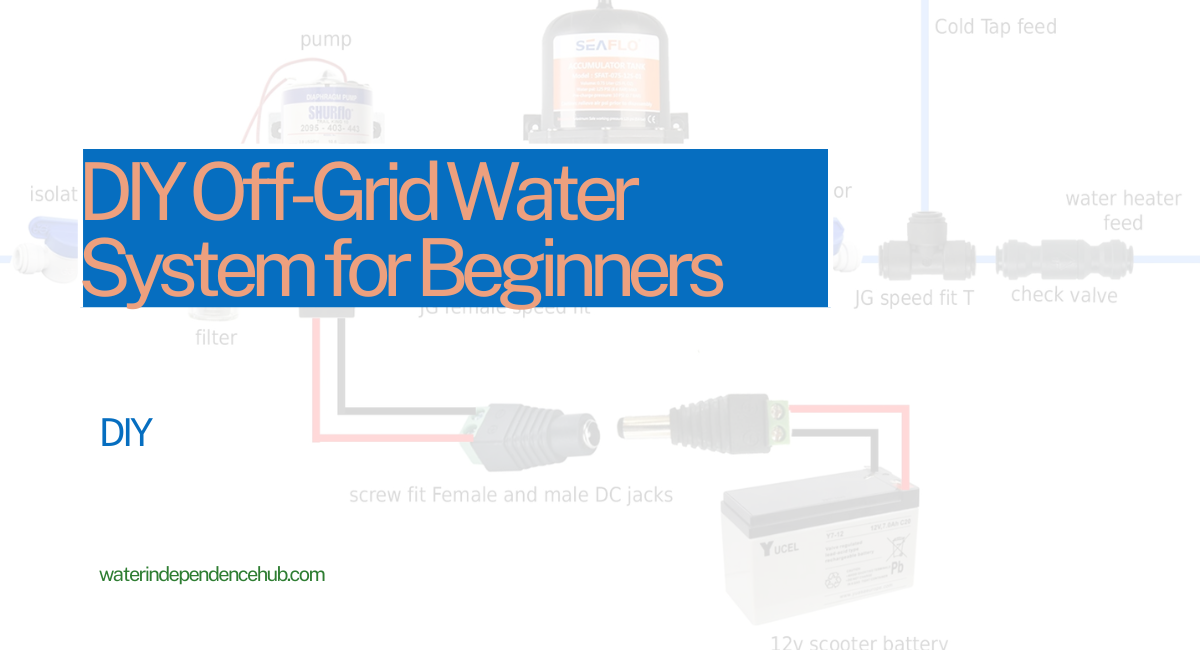
Most off-grid water guides skip straight to the romantic parts; the well, the cistern, the gravity-fed shower in the woods. They leave out the boring math that determines whether the system actually keeps a household running. This guide doesn’t.
What follows is a step-by-step blueprint for a beginner-friendly off-grid water system. Real numbers, real costs, real trade-offs. By the end, you’ll have a clear idea of what your first build should look like, what it will cost, and what to avoid getting wrong.
For the broader picture of how off-grid water fits into a complete homestead setup, our Off-Grid Water Systems Hub is the right starting point. This article goes deep on the build itself.
Key Takeaways
- A beginner DIY off-grid water system can be built for $1,500–$5,000 depending on source and storage.
- The six steps in order: audit usage, pick source, size storage, build filtration, solve distribution, plan for failure.
- Storage is the most underrated piece — most beginner systems are dangerously under-stored.
- Single-source systems fail catastrophically. Always plan for a backup.
- Real-world setup time: 4–8 weeks if you’re hands-on, 2–4 months if you hire help for parts.
Step 1: Audit Your Real Water Use
Before you spec a system, measure what you actually use. Most people guess high or low by a factor of 2x. Two weeks of measurement gives you the real number.
Read your water meter daily. Track per-person usage. Note the seasonal swing summer with a garden looks nothing like winter without one. The honest baseline for a family of four runs 80–120 gallons/day before any conservation. Off-grid living typically cuts that to 40–60 gallons/day, but only if you’ve measured first and conserved deliberately.
Step 2: Pick Your Primary Source
Four real options for off-grid water sourcing: drilled well, rainwater catchment, surface water (creek, spring), or atmospheric water generator. Each has trade-offs we cover in detail in our breakdown of the best off-grid water systems compared. If you’re new to the water-from-air option specifically, the complete guide to water from air covers the basics first.
For a beginner build, the right choice depends on three factors: geography (are you on land with groundwater? Is it legal to harvest rainwater in your state?), budget (a well is $5,000–$15,000 just for drilling; rainwater catchment can start at $1,000), and climate (an AWG is great in humid regions, marginal in arid ones — see how atmospheric water generators work for the engineering, or how to make water from air at home for entry-level methods).
Step 3: Size Storage (The Most Underrated Step)
This is where most beginner systems fail. The math: a family of four needs 200+ gallons/day. A 14-day buffer is the minimum for serious off-grid resilience. That’s 2,800+ gallons of storage — which most beginners massively underestimate. For the full preparedness rationale on storage sizing, see our survival & preparedness hub.
| Storage Format | Capacity | Cost | Best For |
|---|---|---|---|
| 5-gallon BPA-free containers | 5–25 gal | $10–$30 each | Initial supply, easy rotation |
| 55-gallon water barrels | 55 gal | $80–$150 | Beginner backup |
| 250-gallon IBC tote | 250 gal | $150–$300 | Serious medium storage |
| Polyethylene cistern | 1,000–10,000+ gal | $500–$5,000 | Full off-grid base |
The choice between above-ground and underground storage depends on climate. Above-ground is cheaper but freeze-vulnerable in cold regions. Underground is climate-stable but doubles installation cost.
Step 4: Build the Filtration Stack
No off-grid source is drinkable as-is. The minimum stack: sediment pre-filter → carbon filter → UV sterilizer. Add reverse osmosis if your source has chemical contamination (agricultural runoff, post-wildfire ash). Total cost: $300–$800 for a serious whole-house setup. For the deeper chemistry on which contaminants need which method, see our water quality & filtration hub.
For drinking water specifically, an under-sink reverse-osmosis system as a final polishing stage adds another $200–$400 but produces clearly drinkable water from almost any source. We cover the broader filtration landscape in is tap water safe to drink?
Step 5: Solve Distribution and Pressure
Source and storage are romantic. Distribution is where systems quietly fail. Three common approaches:
- Pressure tank + pump. Standard residential setup. Pump fills a pressure tank; tank delivers water on demand. Cost: $400–$900. Needs power.
- Gravity feed. Storage placed 50–60 feet above point-of-use generates ~25 PSI. No power needed. Hard to retrofit unless you have natural elevation.
- Hand pump. Backup option for grid failures. Manual, slow, but always available.
The hidden trap: if your pump runs on grid power, your “off-grid” system is actually grid-dependent. Pair distribution with dedicated solar (600–1,200W panel array, 200+ Ah battery bank) for genuine independence.
Step 6: Plan for Failure
Single-source systems fail catastrophically. The most resilient beginner setup combines two sources: a primary (well or rainwater) plus a backup (rainwater + AWG, or well + storage). When one fails, the other carries the household until repairs happen. For a deeper look at how outages unfold, see what happens if water supply stops.
This also covers the seasonal failure modes — wells that drop in dry years, rainwater catchments that dry up in summer, AWG yields that crash in winter. A two-source system absorbs each one without forcing you back onto a municipal supply.
A Realistic Year-One Budget
| Component | Beginner Build | Serious Build |
|---|---|---|
| Source (well or rainwater) | $1,500 | $8,000 |
| Storage (1,000–5,000 gal) | $500 | $2,500 |
| Filtration stack | $400 | $1,200 |
| Pump + pressure tank | $600 | $1,500 |
| Solar for water system | $0 | $2,000 |
| Total | $3,000 | $15,200 |
The beginner build is grid-tied for distribution but off-grid for source and storage. The serious build is fully grid-independent. Most homesteaders start with the beginner version and upgrade to the serious version over 2–3 years. If you’d rather skip the build and compare commercial alternatives, our residential AWG buyer’s guide covers off-the-shelf options.
If You Want a Documented Build
For households that want a documented, parts-list-included blueprint for one specific piece of this stack — the atmospheric water generator — our Smart Water Box review breaks down the most thorough DIY build we’ve come across, including the cooling design and filtration stack that turns the concept into a working unit.
Keep Reading
- Best Off-Grid Water Systems Compared choose your primary source.
- How Atmospheric Water Generators Work the engineering behind one of the four sources.
- Emergency Water Sources You Can Use backup options when systems fail.
Frequently Asked Questions
How long does it take to build a basic off-grid water system?
If you’re hands-on and have your source already (existing well or roof for rainwater), 4–8 weekends. If you need to drill a well or hire contractors, plan for 2–4 months from decision to first water.
Do I need a permit?
For wells, almost always and the well must be drilled by a licensed driller. For rainwater catchment, usually no, though restrictions exist in some western U.S. states. Surface-water diversion requires permits. Atmospheric water generators are unregulated.
Can I build a system without solar?
Yes, for the source and storage layers. But pumps need power. A grid-tied pump with a hand-pump backup is a reasonable compromise. Fully off-grid distribution requires solar plus battery backup.
What’s the most common beginner mistake?
Under-sizing storage. Beginners often spec 200–500 gallons, then panic during the first dry stretch or repair. Plan for 14 days of stored water minimum, even if the source is reliable.
Is rainwater catchment really legal?
In most U.S. states, yes. A few western states (Colorado, Utah, Washington) had historical restrictions tied to water-rights law, though these have loosened since 2016. Always check your specific state and county before building.
The Takeaway
An off-grid water system isn’t built, it’s iterated. Start with the audit. Pick a source you can support. Over-size storage. Add a backup. Layer in independence over months and years rather than weekends. The households that get it right are the ones who treat it as a system, not a project.
Leave a Reply