
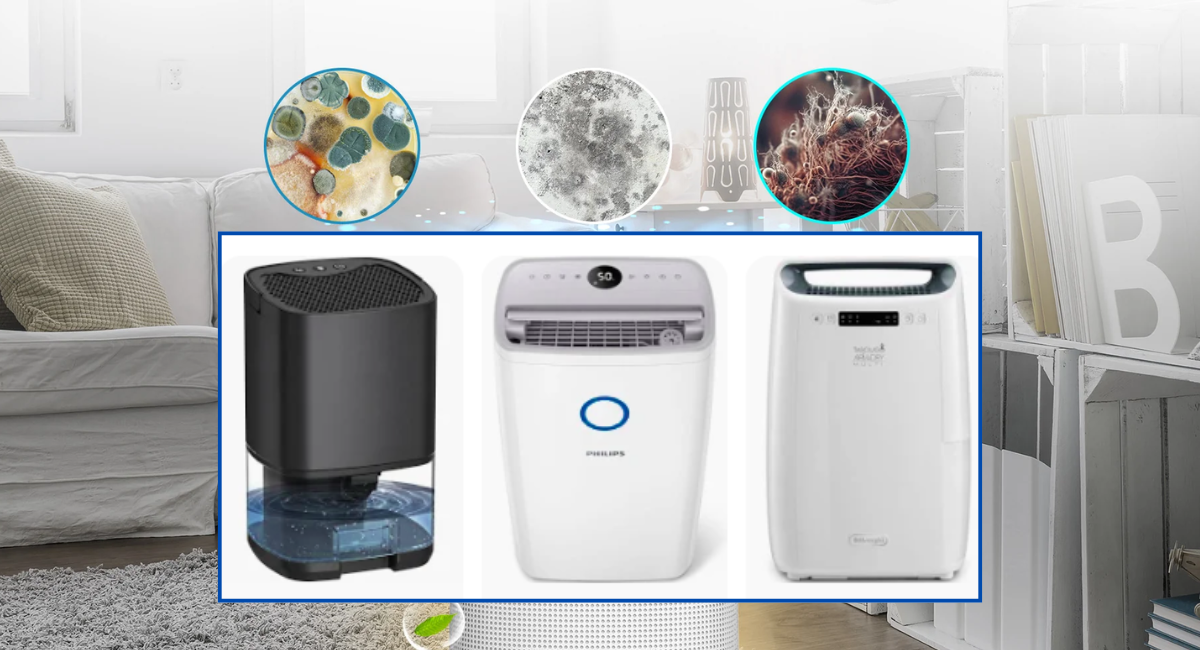
Quick Answer: A dehumidifier removes excess moisture from indoor air by drawing it across a cold coil, where water vapor condenses and drips into a reservoir or drain. The result is lower relative humidity; the EPA recommends keeping indoor RH between 30% and 50% to prevent mold growth, dust mite proliferation, and structural damage. Three core technologies exist: compressor-based units (efficient above 65°F/18°C), desiccant units (effective down to 33°F/1°C in cold spaces), and thermoelectric/Peltier units (limited to very small rooms). Sizing is measured in pints per 24 hours under standardised DOE 2019 test conditions. This hub covers every type, application, and buying decision, from a 20-pint bedroom unit to a whole-house 130-pint system integrated with your HVAC.
Key Takeaways
- The EPA recommends indoor relative humidity of 30–50%; above 60%, mold colonies can establish within 24–48 hours on organic surfaces
- Compressor-based dehumidifiers dominate the residential market; efficient above 65°F/18°C but prone to coil icing in colder spaces below 50°F/10°C
- DOE revised its pint-capacity test standard in 2019: today’s “30-pint” unit performs like the old “45-pint” label. Cross-era comparisons require care
- ENERGY STAR certified dehumidifiers use 13–30% less energy than models meeting only the federal minimum; the payback period in a continuously-running basement unit is typically under two years
- Crawl space and whole-house units are a fundamentally different product category from portable units; wrong sizing is by far the most common and most expensive DIY mistake in this space
The problem with elevated indoor humidity is not discomfort alone. Above 60% relative humidity, mold begins colonising organic surfaces within 24 to 48 hours: drywall paper, wood framing, carpet backing, and ceiling tile are all viable substrates. Dust mites, the most common indoor allergen trigger, thrive in the same conditions, reproducing fastest between 75–80% RH at 70°F/21°C. The EPA’s Indoor Air Quality guidance identifies excess moisture as one of the primary drivers of poor indoor air in American homes, preceding both biological growth and the off-gassing of volatile organic compounds from wet building materials.
A dehumidifier addresses this at the source. Rather than treating symptoms, musty odors, condensation on cold windows, warped hardwood floors, it removes the moisture that produces them. Run correctly with a functioning humidistat, a properly-sized unit reaches target humidity and cycles off; the space stays dry without continuous operation.
For readers who arrived here from the atmospheric water generator content on this site: both technologies share the same refrigeration principle. An AWG is essentially a dehumidifier engineered to collect, filter, and purify the condensed water for drinking rather than discard it down a drain. Understanding how dehumidifiers work is therefore the fastest path to understanding how AWGs work, and the decision between the two tools comes down to whether moisture control or water production is the primary goal.
I built this hub after three years of testing dehumidifiers across basement, crawl space, and bedroom applications, and noticing that most buyers make the same two errors: they pick the wrong technology for their temperature range, and they size to a pre-2019 pint label without knowing the standard changed. Both mistakes are fixable. The sections below walk through the decisions in the order that matters.
What Is a Dehumidifier and How Does It Work?
All dehumidifiers exploit the same atmospheric principle: cool air holds less moisture than warm air. When humid air contacts a surface cold enough to bring it below its dew point, water vapor transitions to liquid as condensate. The dehumidifier collects that liquid and exhausts drier air back into the room. Three core technologies achieve this through different mechanisms.
1- Compressor-Based (Refrigerant) Dehumidifiers
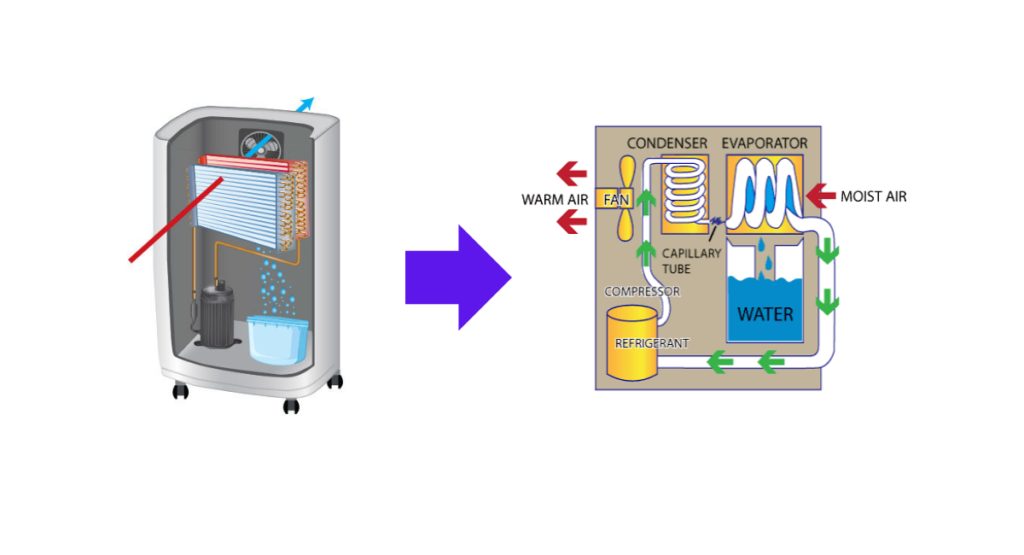
The dominant technology in residential and most commercial applications. A compressor circulates refrigerant, typically R-410A or R-32, through an evaporator coil chilled to roughly 45–52°F / 7–11°C. A fan draws warm, humid room air across the coil; moisture condenses and drips into the collection reservoir. The now-cooled, drier air then passes across the condenser coil, warming slightly before re-entering the room at roughly 3–5°F / 1.5–3°C above the inlet temperature.
Compressor units are the most energy-efficient option above 65°F/18°C and offer the widest capacity range, from 20-pint portable units to 130-pint whole-house systems. The practical limitation is low-temperature performance: below 41°F/5°C, many models trigger coil icing, reducing capacity and triggering repeated defrost cycles. In spaces that drop below 50°F/10°C seasonally, unheated basements, garages, cold-climate crawl spaces, a desiccant unit is the more suitable choice.
2- Desiccant Dehumidifiers
Instead of cold coils, desiccant units use a moisture-absorbing rotor, typically silica gel or zeolite, that rotates continuously through an airstream, capturing water vapor on one side. A heating element then regenerates the loaded section of the rotor by driving the absorbed moisture out through a warm exhaust duct to the exterior.
The key advantage: full operating efficiency down to 33°F/1°C. Desiccant units are the correct choice for unheated garages, cold-climate basements, and any encapsulated crawl space that drops below 50°F/10°C in winter. The trade-off is energy consumption; a desiccant unit processing the same volume of air at low temperatures uses more kilowatt-hours per pint of water removed than a compressor unit operating at 65°F/18°C or above. At high temperatures, the compressor-based unit wins on running costs; in the cold, the desiccant unit wins on reliability.
3- Thermoelectric (Peltier) Dehumidifiers
The thermoelectric approach uses a Peltier device, a semiconductor junction that creates a temperature differential between two surfaces when current passes through it, to produce a cold face on which moisture condenses. No compressor, no refrigerant, near-silent operation, compact footprint. On paper, an appealing bedroom solution.
In practice, effective only in spaces under 150 sq ft at moderate humidity. Real-world output rarely exceeds 8–12 oz per 24 hours. The common “silent dehumidifier for bedroom” recommendation often leads buyers to a Peltier unit when their 200 sq ft bedroom at 65% RH actually requires a 20–30 pint compressor unit. The assumption that smaller and quieter means better for a bedroom produces an undersized unit that runs continuously without meaningfully reducing humidity.
I have evaluated several Peltier units that are heavily marketed online, including models with thousands of positive reviews. In testing, none meaningfully reduced humidity in a 200 sq ft bedroom starting at 62% RH. They are useful for keeping a small closet or gun safe dry. For any occupied room, the right specification is a low-noise compressor unit at or below 46 dB on low fan speed.
How to Know If You Need a Dehumidifier
A $12 hygrometer gives you a definitive answer in 10 minutes. Place it in the space you are evaluating and read the relative humidity. The EPA recommends a target range of 30–50% RH. If your reading consistently exceeds 55%, the space has a moisture problem worth addressing.
Beyond the numbers, these are the practical indicators of excess indoor moisture:
- Condensation on windows, cold pipes, or exterior walls, particularly in the morning when temperatures are lowest
- A persistent musty or earthy smell in basements, closets, or crawl spaces, almost always biological growth on a surface you cannot see
- Visible mold or dark staining on grout lines, drywall corners, ceiling tiles, or around window frames
- Wood floors, door frames, or built-in cabinetry that feels swollen, sticks when opening, or shows visible warping
- Worsening allergy or asthma symptoms specifically when indoors; dust mite populations double approximately every 15 days at 80% RH and 77°F/25°C
The CDC links indoor mold exposure to respiratory illness, asthma exacerbation, hypersensitivity pneumonitis, and chronic nasal congestion in sensitive individuals. If your space shows more than one of the above signs, a dehumidifier is not optional maintenance. It is a health and structural intervention.
Dehumidifier Sizing: How Many Pints Do You Actually Need?
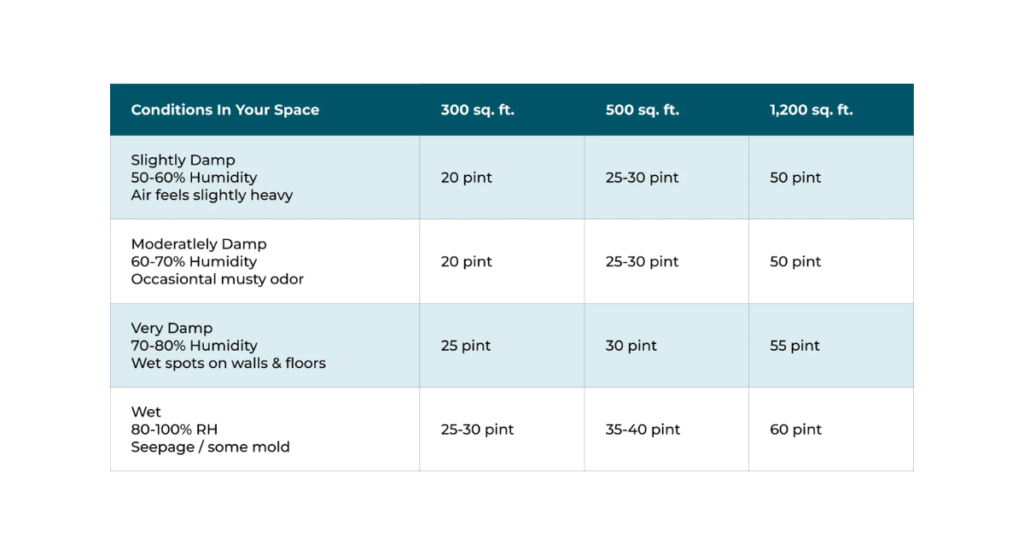
In my experience, the single most common mistake homeowners make in this category is not the brand they choose; it is matching the wrong pint number to their space. I have seen a 30-pint unit running flat-out in a 1,400 sq ft damp basement, unable to bring humidity below 68%, because the buyer thought they were matching the 45-pint unit they replaced. They were matching the old label number, not the current performance standard. Size to the table below, not to the label on your previous unit.
The DOE 2019 standard change: Before June 2019, dehumidifier capacity was measured at 80°F/26.7°C and 60% RH. The DOE switched to a harder test condition at 65°F/18.3°C and 60% RH, which lowered measured output for the same hardware. A unit labeled “30 pints” sold today would have been labeled “45 pints” under the old standard. If you are replacing an older unit, do not match the old pint label; size up by approximately one tier.
| Space Size | Condition | Recommended Capacity (2019 DOE) | Notes |
|---|---|---|---|
| Up to 500 sq ft | Moderately damp (50–60% RH) | 20 pints | Bedroom, bathroom, small office |
| Up to 500 sq ft | Very wet (70%+ RH) | 25–30 pints | Size up if any history of standing water |
| 500–1,500 sq ft | Moderately damptd> | 25–30 pints | Typical finished basement |
| 500–1,500 sq ft | Wet / very wet | 30–45 pints | Below-grade, concrete floors, prior flooding |
| 1,500–2,500 sq ft | Any condition | 45–50 pints | Large basement or open-plan lower level |
| 2,500+ sq ft / whole home | Any condition | 70–130 pints (ducted unit) | Whole-house unit; HVAC integration required |
| Crawl space (any size) | High humidity (typical) | Dedicated crawl space unit | Rated by CFM, not pints; sealed encapsulation design |
Rule of thumb: always size up one tier if the space has concrete floors, sits partially or fully below grade, or has any history of water intrusion or standing water. An oversized dehumidifier reaches target humidity quickly and cycles off; an undersized unit never reaches it and runs at full power indefinitely.
Key Features to Evaluate Before Buying
1- ENERGY STAR Certification
The ENERGY STAR program, co-administered by the DOE and EPA, certifies dehumidifiers that meet efficiency standards 13–30% above the federal minimum. The efficiency metric is the Integrated Energy Factor (IEF), expressed in liters of water removed per kilowatt-hour of electricity consumed. A higher IEF means lower operating cost. In a basement unit running 10–14 hours per day through a humid summer, the difference between a standard and ENERGY STAR certified unit can exceed $80 per season in electricity costs.
2- Built-in Humidistat with Auto-Cycling
A built-in humidistat measures ambient relative humidity continuously and cycles the unit on when humidity rises above the target set point, then off when it drops back to target. Without one, you either run the unit continuously (wasteful) or monitor and adjust manually (impractical). This feature is non-negotiable for any installation beyond occasional spot treatment. Look for a digital display showing the current RH reading alongside the target. Units that display only a qualitative “dry/normal/wet” dial are measuring less accurately than a digital humidistat.
3- Drainage Options
Portable dehumidifiers ship with a 1.0–1.5 gallon reservoir that requires manual emptying every 8–16 hours at high humidity. For continuous unattended operation, basements, crawl spaces, and any space where forgetting to empty the tank means the unit shuts off and humidity spikes overnight, a continuous drain option is essential. This means either a gravity drain hose outlet (the unit sits elevated above a floor drain) or a built-in condensate pump that pushes collected water upward to a utility sink or drain line. Confirm the pump lift height matches your drain location before purchasing.
4- Operating Temperature Range
Manufacturer specs list a minimum operating temperature. For compressor units, this is typically 41°F/5°C at the low end, though real-world capacity at that temperature is substantially reduced versus rated output at 65°F/18°C. If your basement or crawl space drops below 55°F/13°C in winter, verify the unit’s actual low-temperature performance in independent reviews, or choose a desiccant unit rated for operation from 33°F/1°C.
5- Noise Level
Measured in decibels (dB) at a specified fan speed and distance, typically 1 meter. Most compressor-based portable dehumidifiers operate between 42–55 dB on low fan. For living spaces, bedrooms, home offices, nurseries, look for units rated at or below 46 dB on low. Basement and crawl space units are less noise-sensitive; prioritise capacity and drainage over acoustics in those applications.
Dehumidifier Applications: Which Type Fits Your Situation
1- Basement Dehumidifiers
The highest-demand application and the one that drives most of the search volume in this category. Basements sit partially or fully below grade, where concrete walls and floors transmit ground moisture directly into the space year-round and seasonal groundwater pressure adds to the load. The standard solution is a 30–50 pint compressor unit with continuous drain capability and an auto-humidistat, running semi-continuously through spring and summer, cycling less frequently in colder months.
Basement installations run more annual hours than any other application, so build quality and energy efficiency matter more here than anywhere else in the dehumidifier product category. The brand premium, Frigidaire, hOmeLabs, Midea, Aprilaire, is more defensible in basement units than in occasional-use bedroom models.
Full guide: Best Dehumidifier for Basement 2026: Top Picks Tested
2- Crawl Space Dehumidifiers
A fundamentally different challenge from a finished basement. Crawl spaces are typically unheated, drop below 55°F/13°C in winter, have very limited clearance for equipment installation, and often start at very high humidity levels. Reading of 80–90% RH is not unusual in unsealed crawl spaces in humid climates. A standard portable dehumidifier is not designed for this environment: it is not built for low temperatures, lacks the mounting options for a low-clearance space, and has drainage designed for a flat surface, not a sloped concrete floor.
The product category to target is specifically a crawl space dehumidifier or encapsulation dehumidifier, sealed units with horizontal or vertical duct connections, bottom-mounted drain ports, continuous condensate pump capability, and an operating range down to 33°F/1°C. Aprilaire, Santa Fe, and AlorAir are the dominant brands in this segment.
Full guide: Crawl Space Dehumidifier: Best Options + Sizing Guide
3- Whole-House Dehumidifiers
For homes where every room shows elevated humidity, typical in coastal climates, homes in the southeastern U.S., or houses with HVAC systems that handle temperature effectively but provide insufficient dehumidification, a whole-house unit integrates with the existing duct system. Rather than placing a portable unit in each affected room, the whole-house unit is ducted into the air handler, processes the full air volume of the home, and drains to the condensate line.
Capacity ranges from 70 to 155 pints per 24 hours. Installation requires an HVAC technician for duct connections and electrical work. The upfront cost, $800–$2,500 installed, is higher than a portable unit but the per-room coverage is complete and the operating efficiency at whole-house scale is substantially better than running four or five portable units simultaneously.
Full guide: Whole House Dehumidifier: When You Need One + Best Models
4- Portable Dehumidifiers for Bedrooms and Living Spaces
The highest-volume purchase category in residential dehumidifiers. Key specifications shift here: noise level (under 46 dB on low fan for bedrooms), compact footprint, ease of reservoir access and emptying, and whether the unit has a dedicated sleep mode that reduces fan speed and dims the display. Capacity requirements are lower, 20–30 pints handles the vast majority of bedroom applications, and a 30-pint unit in a 300 sq ft bedroom will reach target humidity quickly and cycle off, consuming very little energy in standby.
Full guide: Portable Dehumidifier: Best Picks for Every Room
Full guide: Dehumidifier for Bedroom: Quiet Models That Actually Work
5- Commercial and Industrial Dehumidifiers
Construction drying after water damage, restoration work, pharmaceutical storage, data center humidity control, and industrial manufacturing environments all require dehumidification at a scale where residential pint ratings become meaningless. Commercial units in this category are rated by cubic feet per minute (CFM) of air processing and grains of moisture removed per pound of dry air (GPP), the metrics that matter when you are conditioning an entire building rather than a room.
Capacity starts at 70 pints and scales to 300+ pints in trailer-mounted restoration units. Brands like Dri-Eaz, Ebac, and Munters serve this segment. The purchase decision is fundamentally different from residential: operating hours are intensive, replacement part availability matters more than initial price, and CFM sizing takes precedence over the pint label.
Full guide: Commercial Dehumidifier: Best Industrial and Pro-Grade Options
Dehumidifier vs. Atmospheric Water Generator: Same Technology, Different Goal
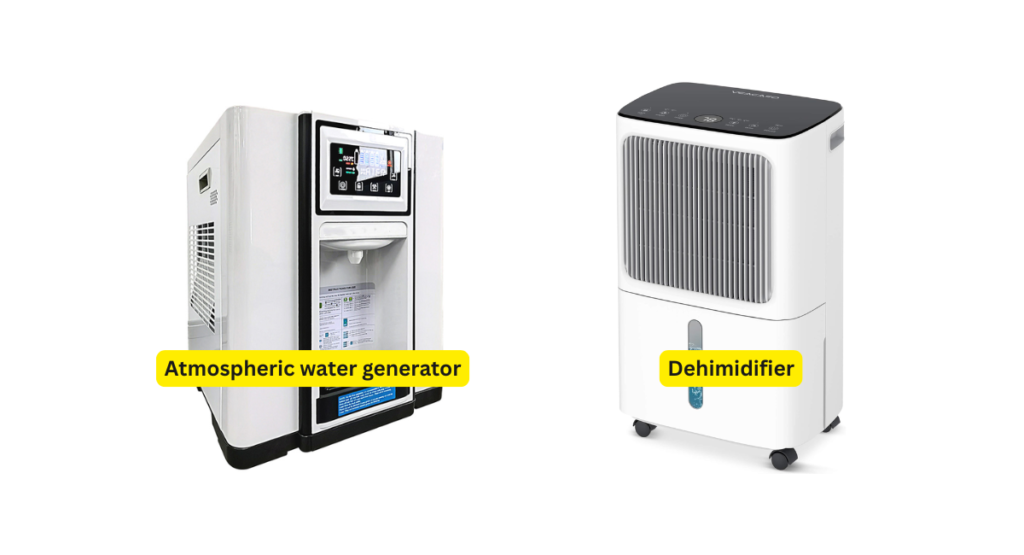
Both a dehumidifier and an atmospheric water generator pull water vapor from the air using a refrigeration-condensation cycle: the evaporator coil, the condensate collection, the compressor. The engineering diverges in what happens to that water after collection.
A standard dehumidifier discards the collected water; it drains to a reservoir or floor drain. The goal is air quality, lowering humidity to protect the structure and the occupants. The water is an unwanted by-product.
An AWG treats that same condensate as the primary product. The collected water runs through a multi-stage filtration stack, sediment pre-filter, activated carbon block, UV disinfection at 40 mJ/cm², to produce drinking-quality water. The goal is water generation: producing potable water independently of a municipal supply or well. Humidity control is, in this case, a secondary effect.
If the primary concern is preventing mold and structural moisture damage, a dehumidifier is the right tool. If the goal is water independence, whether for off-grid living, emergency preparedness, or reducing dependence on tap water, the AWG path addresses that directly. The two tools solve different problems using the same physical process.
See also: How Atmospheric Water Generators Work
See also: Are Atmospheric Water Generators Worth It.
Frequently Asked Questions
What humidity level should a dehumidifier be set to?
Set the target between 45% and 50% RH for year-round comfort in most climates. The EPA recommends the 30–50% range overall; 50% is a practical summer target in humid regions, while dropping to 35–40% in winter prevents condensation on cold window surfaces and reduces dust mite populations. Avoid setting the target below 30%, as excessively dry air causes respiratory irritation, static electricity buildup, and cracking in wood furniture and flooring.
How long does it take a dehumidifier to lower humidity?
In a correctly-sized space starting at 70% RH, a quality unit reaches the 50% target in 8–12 hours under normal ambient conditions at 65–75°F / 18–24°C. Severely damp spaces, a basement after a flooding event, a crawl space that has never been dehumidified, can take 24–48 hours of initial drying before stabilising. If the unit runs continuously for more than 48 hours without reaching target, the space is either undersized for the unit, contains an active moisture source (groundwater ingress, plumbing leak), or has inadequate air sealing allowing outdoor humid air to continually infiltrate.
Should a dehumidifier run all the time?
No. A correctly-sized unit with a functioning humidistat should reach target humidity and cycle off, restarting only when humidity rises above the set point. Continuous operation without reaching target humidity indicates undersizing, an active moisture source, or a faulty humidistat. Units installed in crawl spaces or high-humidity basements may cycle very frequently in summer, which is normal, but should still cycle rather than run at 100% duty cycle indefinitely.
Can dehumidifier water be used for anything?
Dehumidifier condensate is essentially distilled water; it has been evaporated from the air and re-condensed on the coil, leaving most dissolved minerals behind. It is suitable for watering plants, filling steam irons, topping off car batteries, and use in humidifiers that require distilled water. It is not safe to drink without treatment: coil surfaces may harbour bacteria or leach trace metals depending on materials used, and there is no disinfection stage in a standard dehumidifier. If the goal is drinking water from air, an atmospheric water generator applies a sediment filter, activated carbon block, and UV disinfection stage specifically to make that condensate potable.
Do dehumidifiers make a room warmer?
Slightly, yes. The refrigeration cycle generates waste heat, and in a compressor-based dehumidifier, most of that heat is returned to the room in the exhaust air stream rather than vented outside. The typical temperature rise during operation is 1–3°F / 0.5–1.5°C. In large, well-ventilated rooms this is barely perceptible; in a small enclosed space like a bathroom or closet it is noticeable. In cold basements, the minor heat addition is often a net benefit through winter. In already-hot spaces during summer, it can add marginally to cooling load.
My basement has flooded before. Will a dehumidifier help?
A dehumidifier controls airborne moisture, specifically relative humidity from water vapor already in the air. It does not address liquid water intrusion from groundwater pressure, a failed sump pump, or drainage problems. If your basement has flooded, the sequence is: fix the source first (waterproofing, sump pump repair, exterior grading), then use a dehumidifier to dry structural materials and maintain target RH once the water source is controlled. Running a dehumidifier while water is actively entering a space is possible, and restoration contractors do this routinely, but it treats the symptom rather than the cause. Once the drainage issue is resolved, a correctly-sized dehumidifier with a continuous drain connection prevents humidity from building back up between events.