
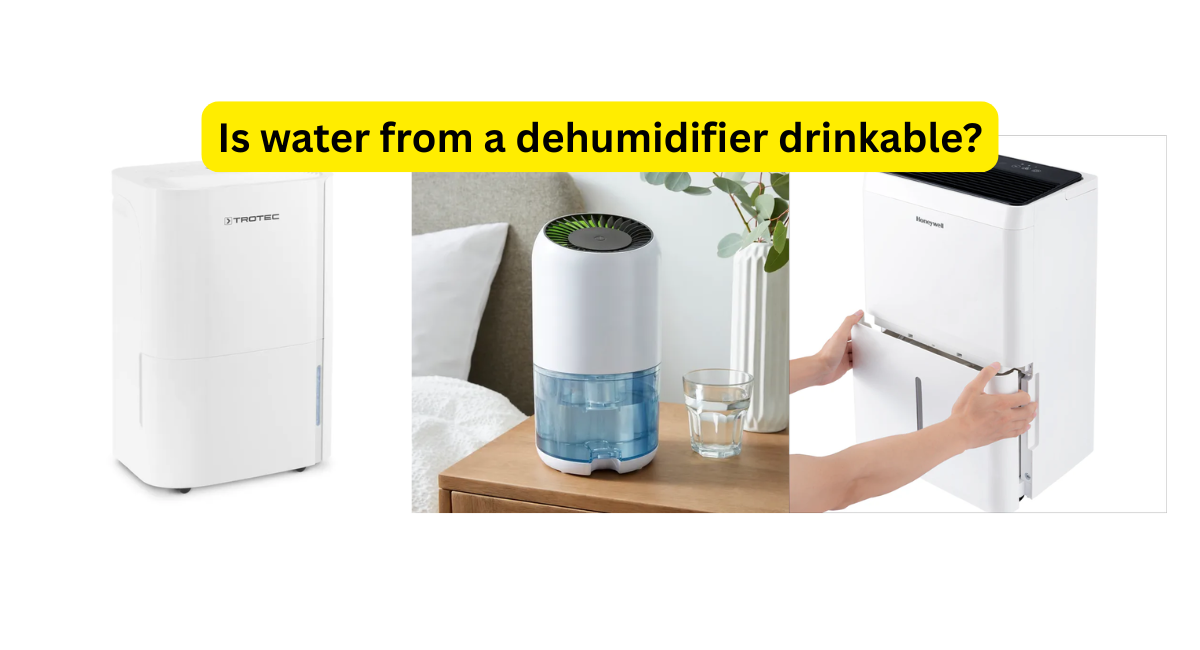
Quick Answer: No, dehumidifier condensate is not safe to drink. The water a dehumidifier collects has passed through unfiltered indoor air carrying mold spores, dust, and airborne bacteria, then contacted metal evaporator coils that can leach copper and aluminum. It is chemically similar to distilled water but biologically unsafe. An atmospheric water generator uses the same condensation physics but adds pre-filtration of the intake air, activated carbon and sediment post-filtration of the condensate, and UV disinfection at 40 mJ/cm² which is what makes AWG output potable. If you want to drink water harvested from air, the right device is an AWG, not a dehumidifier with a bucket.
Key Takeaways
- Dehumidifier condensate is technically distilled (mineral-free) but not potable: it picks up biological contaminants from indoor air and coil surfaces that standard distillation does not remove.
- The CDC’s indoor air quality guidance does not approve dehumidifier water for human consumption; it is suitable for non-potable uses like watering plants, topping up steam irons, or battery maintenance.
- A dehumidifier running in a basement at 70% RH can collect 10 to 15 gallons of water per day, water that is being discarded into a drain. That same volume, properly treated, could supply drinking water for a household of four.
- Atmospheric water generators solve this by engineering the entire condensation process around potability from the start: filtered air intake, sealed condensate path, multi-stage filtration, UV disinfection.
- The one exception where dehumidifier water is sometimes used: emergency situations where no other water source is available. Even then, boiling is the minimum treatment, and it does not remove heavy metals.
A 50-pint basement dehumidifier running through a humid July will collect roughly 6 gallons of water per day and send every drop down the floor drain. The obvious question, the one I get asked regularly is whether any of that water is usable. The short answer is: usable, yes, for some things. Drinkable, no. The longer answer involves understanding what happens to water on its way through a dehumidifier, which also explains why atmospheric water generators exist as a separate product category.
Why Dehumidifier Water Looks Safe But Is Not
The condensation process in a dehumidifier is physically identical to distillation: warm air contacts a cold surface, water vapor condenses into liquid, and the resulting water is almost entirely free of dissolved minerals. If you test dehumidifier condensate with a TDS (Total Dissolved Solids) meter, you will typically read 0 to 10 ppm lower than most bottled water, lower than tap water in virtually any U.S. city. That reading is why people assume it is safe.
The TDS reading is misleading here. TDS measures dissolved minerals. It does not measure biological contamination, volatile organic compounds (VOCs), or metals leached from coil surfaces. A glass of distilled water with a dead mouse in it would still read 0 ppm TDS. The measurement tells you what is not in the water, not whether what is in the water is safe.

What Is Actually in Dehumidifier Condensate
Three contamination pathways distinguish dehumidifier condensate from treated drinking water:
1- Airborne Biological Contaminants
A dehumidifier draws air from wherever it is placed. In a basement at 70% RH, that air contains elevated concentrations of mold spores (Cladosporium, Aspergillus, Penicillium are the most common basement species), dust mite particulate, and in some cases aerosolized bacteria from standing water or damp organic material. That air passes directly over the evaporator coil before the condensate is collected. The coil itself, if not cleaned regularly, becomes a surface for microbial growth and that growth sheds into the condensate reservoir. There is no filter between the room air and the collected water in a standard dehumidifier.
2- Coil and Reservoir Surface Contaminants
Dehumidifier evaporator coils are typically made from aluminum fins bonded to copper tubing. Over time, both metals can leach trace amounts into collected condensate, particularly as the coil corrodes or develops surface oxidation in humid conditions. The plastic reservoir is usually not food-grade certified and may off-gas plasticizers (phthalates or BPA depending on the manufacturer and production year) into the water it holds. These concentrations are typically low but are not tested or certified for potability in consumer dehumidifiers.
2- No Treatment Stage
The fundamental problem is architectural: a dehumidifier is not designed with potability as a goal. It has no filtration stage, no UV treatment, no sealed condensate path that prevents post-collection contamination. The collected water sits in an open reservoir until you empty it, exposed to the same air the unit is processing. Every hour the reservoir sits, biological growth potential increases.
What You Can Use Dehumidifier Water For
Its near-zero mineral content actually makes dehumidifier condensate useful for several applications where mineral deposits are the problem, not biological contamination:
- Watering houseplants: Most tap water contains chlorine and minerals that some sensitive plants (orchids, carnivorous plants) do not tolerate well. Dehumidifier water is mineral-free and effectively the same as rain water for plant purposes.
- Steam irons and humidifiers: Mineral-free water prevents limescale buildup in steam irons, garment steamers, and cool-mist humidifiers. This is the most common legitimate use.
- Topping off lead-acid batteries: Automotive and marine batteries require distilled or deionized water; dehumidifier condensate meets that standard.
- Rinsing tools or equipment where mineral deposits from tap water cause problems.
For any use that involves human ingestion — including cooking, making coffee, or brushing teeth — dehumidifier condensate is not appropriate without treatment that goes well beyond what a home filter pitcher can provide.
How Atmospheric Water Generators Solve the Same Problem Safely
An atmospheric water generator and a dehumidifier use the same refrigeration cycle: a compressor cools a coil, warm humid air contacts the coil, water condenses, and collects. The physical process is identical. What differs is everything that happens before and after condensation.
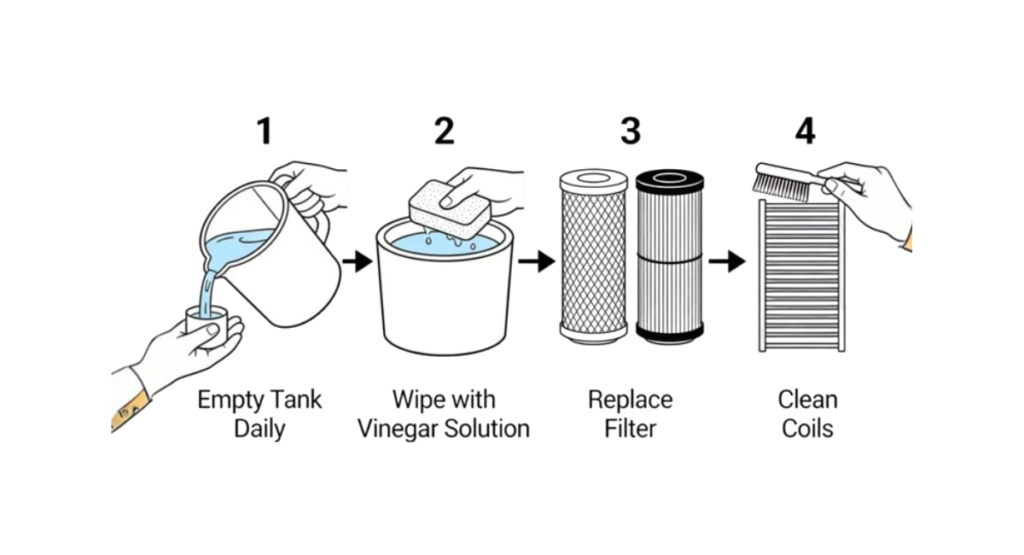
AWGs address each of the three contamination pathways that make dehumidifier condensate unsafe. Air intake filtration (typically a washable pre-filter plus HEPA-grade filtration on higher-end units) removes biological particulate before air contacts the coil. The condensate path is sealed and food-grade-certified from coil to storage tank. Post-condensation treatment typically includes a sediment pre-filter, an activated carbon block stage that removes VOCs and coil-contact compounds, and UV disinfection at 40 mJ/cm² the same UV dose used in municipal water treatment systems which eliminates bacterial and viral contamination at 99.9%+ efficacy.
The output of a well-maintained AWG in normal operating conditions meets EPA drinking water standards for biological contamination, which is the primary concern. For a full explanation of how the refrigeration cycle, filtration stack, and UV treatment interact in a purpose-built AWG, read How Atmospheric Water Generators Work.
This also explains why AWGs cost significantly more than dehumidifiers of equivalent capacity: you are paying for the filtration engineering, the sealed condensate path, the UV system, and the food-grade certified materials throughout. A dehumidifier is cheaper because it is not engineered to produce water you would put in your body.
For homeowners who already have a basement dehumidifier and are curious about water independence options, the starting point is the Dehumidifier Hub, which explains the full technology landscape, and then the AWG buyer’s guide for the path to potable water from air.
Frequently Asked Questions
Is dehumidifier water the same as distilled water?
Chemically similar but not equivalent. Both have near-zero mineral content (0 to 10 ppm TDS). The difference is the production environment: distilled water is produced from a sealed, sterilized system where the source water is boiled and the steam is condensed in a clean vessel. Dehumidifier condensate is produced from unfiltered indoor air, condensed on metal coils that may harbor biological growth, and collected in an unsealed reservoir. The mineral profile may be similar; the biological and chemical safety profile is not.
Can you filter dehumidifier water to make it drinkable?
In theory, yes — with the right treatment stack. You would need: a sediment pre-filter, an activated carbon block to remove VOCs and metal traces, a UV disinfection stage at 40 mJ/cm² minimum, and a post-filter. That treatment stack is exactly what an AWG contains built-in. Building it as an aftermarket addition to a dehumidifier is technically possible but costs more than purchasing an AWG designed for the purpose, without the food-grade certified condensate path that makes the whole system reliable.
Why does dehumidifier water have no minerals?
Condensation is inherently a de-mineralization process. When water evaporates from soil, ocean, or any surface, the minerals stay behind — only water molecules move into the vapor phase. When that vapor condenses on a cold surface, the resulting liquid is essentially mineral-free. This is the same reason rainwater has low TDS before it contacts soil or rock. The absence of minerals is not a safety feature; it is simply a property of the condensation process.
What is the difference between an AWG and a dehumidifier in terms of daily water output?
A residential AWG typically produces 3 to 10 gallons of potable water per day depending on ambient temperature and humidity, with higher output at 80°F/27°C and 80% RH than at 65°F/18°C and 50% RH. A 50-pint basement dehumidifier removes roughly 6 gallons of water per day at test conditions, but that water is discarded. AWGs are optimized for lower-volume, higher-quality output; dehumidifiers are optimized for maximum moisture removal with no regard for water quality.
Can I use dehumidifier water in a fish tank?
With caution, and only after testing. Freshwater fish require water that is free of chlorine (dehumidifier water has none) but with some mineral content for electrolyte balance — which dehumidifier water largely lacks. You would typically mix it with tap water that has been dechlorinated, not use it straight. More importantly, if the dehumidifier has any mold growth on the coil or in the reservoir, those spores and the mycotoxins they produce can harm aquatic life. Clean the unit and test the condensate before using it in an aquarium.

Leave a Reply