
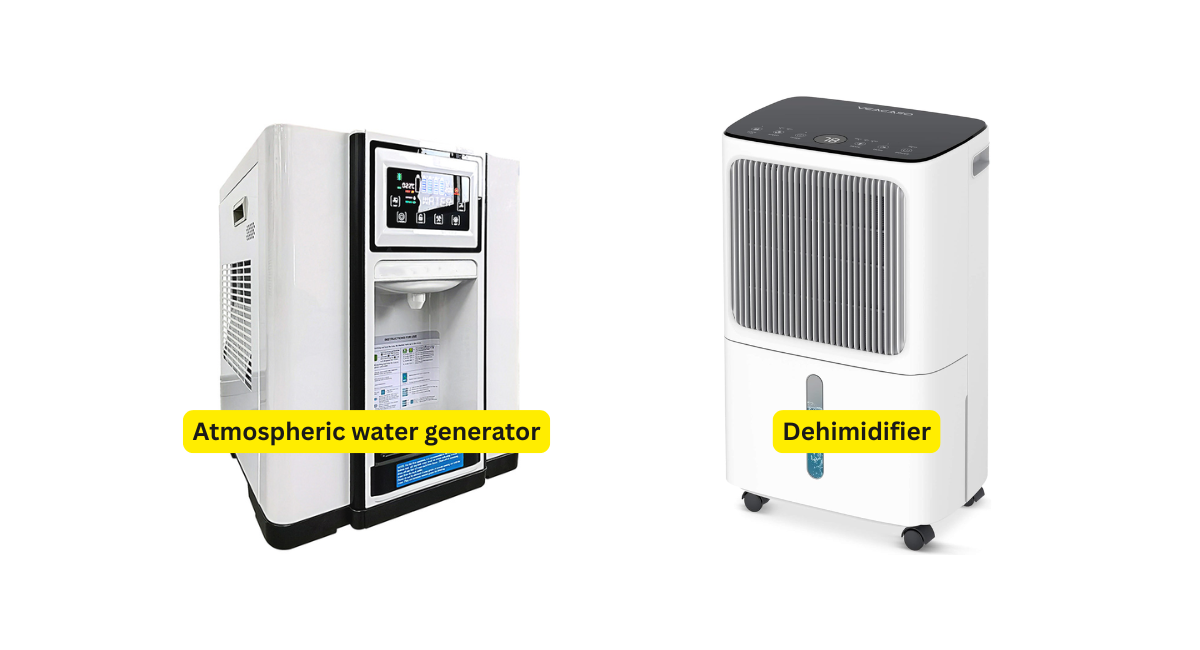
Quick Answer: An atmospheric water generator (AWG) and a dehumidifier share the same core technology: a refrigeration cycle that cools a coil below the dew point so water vapor in the air condenses into liquid. The difference is not the physics. It is the engineering goal. A dehumidifier is optimized to remove as much moisture from the air as possible, as fast as possible, and discard it. An AWG is optimized to produce clean potable water from that same condensation, with intake air filtration, a sealed food-grade condensate path, multi-stage filtration, and UV disinfection at 40 mJ/cm². Same mechanism. Opposite priority.
Key Takeaways
- Both AWGs and dehumidifiers use compressor-based refrigeration to condense water vapor from air. The evaporator coil, compressor, condenser, and expansion valve are present in both.
- A dehumidifier is engineered around throughput: maximum liters of water removed per kilowatt-hour of energy consumed. ENERGY STAR rates this as Integrated Energy Factor (IEF) in liters/kWh.
- An AWG is engineered around water quality: every design choice from intake air filtration to UV dose is made to ensure the output meets potable water standards.
- A dehumidifier and an AWG in the same room serve different purposes and do not compete. One protects the structure and air quality; the other produces drinking water.
- The water a dehumidifier discards is not wasted in any meaningful ecological sense — it returns to the water cycle. But in a water-scarce context, an AWG captures and purifies that same atmospheric water for use.
The question comes up more than you might expect, often from homeowners who run a basement dehumidifier and have started thinking about water independence: if the machine is already pulling gallons of water out of the air every day, why can they not drink that water? The answer reveals exactly what separates these two product categories, and why both exist.
The Shared Refrigeration Cycle
Both devices run on the vapor-compression refrigeration cycle, the same system that runs your refrigerator and air conditioner. A compressor pressurizes a refrigerant gas, which condenses into liquid in a condenser coil (releasing heat). The liquid refrigerant then passes through an expansion valve, depressurizes, and evaporates in the evaporator coil, absorbing heat and dropping the coil temperature well below the dew point of the surrounding air — typically to 45 to 55°F/7 to 13°C in residential equipment. When humid room air contacts this cold coil, water vapor condenses into liquid droplets that run off the coil into a collection area.
That is the entire shared mechanism. After that condensation step, the two products do entirely different things with the water they have collected.
Side-by-Side Comparison
| Feature | Dehumidifier | Atmospheric Water Generator |
|---|---|---|
| Core mechanism | Vapor-compression refrigeration | Vapor-compression refrigeration |
| Primary goal | Remove moisture from air; protect structure | Produce potable water from air |
| Air intake filtration | Basic mesh dust filter (non-HEPA) | Pre-filter + HEPA or equivalent; air filtered before coil contact |
| Condensate path | Open plastic reservoir, not food-grade certified | Sealed food-grade certified path from coil to storage tank |
| Post-collection treatment | None | Sediment filter, activated carbon block, UV at 40 mJ/cm² |
| Output water use | Discarded (drain or manual emptying) | Potable drinking water |
| Daily output volume | 20 to 70 pints (2.5 to 8.75 gallons) at DOE 2019 conditions | 3 to 10 gallons at optimal conditions (80°F/27°C, 80% RH) |
| Efficiency metric | Integrated Energy Factor (IEF) — liters/kWh | Liters per kWh (water produced, not merely removed) |
| Optimal placement | Basement, crawl space, bathroom, any high-humidity space | Living space, kitchen, utility room — anywhere with 65°F+/18°C+ and 50%+ RH |
| Typical cost range | $150 to $350 (portable); $650 to $2,500 (crawl space) | $1,200 to $4,000 (residential); $5,000+ (whole-home) |
Where the Engineering Diverges
The divergence starts at the air intake. A dehumidifier pulls room air across the evaporator coil through a mesh screen that catches large dust particles. The goal is to keep the coil clean enough to maintain airflow efficiency — it is a maintenance filter, not a contamination control filter. An AWG’s intake filtration is designed around potability: the air that contacts the coil must be clean because anything it carries (mold spores, bacteria, particulate) can end up in the condensate. Higher-end residential AWGs use a washable pre-filter plus a HEPA-grade secondary filter before the air ever reaches the coil surface.
The condensate path diverges next. In a dehumidifier, water drips from the coil into a removable plastic bucket or through a gravity hose to a drain. The bucket is not food-grade certified, sits open to ambient air between emptyings, and is a known site for mold and bacterial growth if not cleaned regularly. An AWG’s condensate path is sealed and food-grade certified from the coil surface through the storage tank. The water does not contact ambient air after condensation.
The most significant divergence is post-collection treatment. A dehumidifier has none. An AWG puts the collected water through a treatment stack before it reaches the tap: a sediment pre-filter removes particulate down to 5 microns (µm), an activated carbon block adsorbs volatile organic compounds (VOCs), residual metals from coil contact, and taste/odor compounds, and a UV disinfection chamber at 40 mJ/cm² delivers the same dose used in municipal water treatment to eliminate bacterial and viral contamination at 99.9%+ efficacy. Some units add a post-UV carbon polish and a remineralization stage to add back beneficial minerals that condensation removes.
Which Do You Actually Need?
These are not competing products for the same use case. The right question is not “AWG or dehumidifier?” — it is whether you have a humidity problem, a water supply problem, both, or neither.
You need a dehumidifier if your basement, crawl space, or living areas exceed 60% RH regularly. At 60% RH and above, conditions are favorable for mold growth; the EPA identifies relative humidity control as the primary prevention mechanism for indoor mold. A dehumidifier running at 45 to 55% RH eliminates the conditions for biological growth, protects structural wood and finished surfaces, and improves air quality. The full selection and sizing guide is in the Dehumidifier Hub, which covers every application from basements to crawl spaces.
You need an AWG if you are pursuing water independence — reducing or eliminating your dependence on municipal supply, well water, or bottled water, particularly in regions with water quality issues, supply disruptions, or infrastructure concerns. An AWG is also the right tool for off-grid properties, emergency preparedness, or any situation where a reliable independent water source matters more than the per-gallon cost. For the full explanation of how AWGs produce potable water from air, see How Atmospheric Water Generators Work.
Many households run both: a crawl space or basement dehumidifier protecting the structure, and an AWG in the kitchen or utility room producing drinking water. They draw from the same atmospheric moisture resource and complement each other without interference. For a practical look at the buyer’s side of the dehumidifier category, the Best Dehumidifier for Basement guide covers sizing, placement, and the most reliable options by price tier.
Frequently Asked Questions
Can I convert my dehumidifier into an atmospheric water generator?
Not practically. You would need to add a sealed food-grade condensate path replacing the existing open bucket, a HEPA-grade intake filter upstream of the evaporator coil, a post-collection sediment filter, an activated carbon block, and a UV disinfection chamber at 40 mJ/cm². The modifications require redesigning the internal plumbing, replacing the intake housing, and certifying food-grade materials throughout — a project that would cost more than purchasing a purpose-built AWG and would not carry any safety certification. The engineering in an AWG is not add-on hardware; it is integrated into the product design from the start.
Do AWGs and dehumidifiers use the same amount of electricity?
At similar water-extraction rates, power consumption is in the same range — both use compressor-based refrigeration, which is the primary energy draw. A 50-pint ENERGY STAR dehumidifier typically consumes 440 to 700 watts. A residential AWG producing 3 to 8 gallons per day typically consumes 300 to 800 watts. The key difference is throughput vs. quality: the dehumidifier moves more water per kilowatt-hour because it is not running filtration pumps, UV lamps, or pre-filtration systems. AWG electricity costs per gallon of potable water produced are higher than dehumidifier costs per gallon of moisture removed, reflecting the additional treatment stages.
Can an AWG double as a dehumidifier?
In the sense that both remove moisture from the air, yes — an AWG operating in a room will reduce the room’s relative humidity as a side effect. However, AWGs are typically placed in living spaces at temperatures of 65°F/18°C and above, produce 3 to 10 gallons per day, and cycle through far less air volume per hour than a dedicated dehumidifier. A 50-pint dehumidifier moves 100 to 200 CFM (cubic feet per minute); a residential AWG moves 40 to 80 CFM for water collection purposes. For serious humidity control in a basement or crawl space, a dedicated dehumidifier outperforms an AWG on moisture removal by a significant margin.
At what humidity level does an AWG stop working effectively?
Most residential AWGs require a minimum of 45 to 50% RH and a temperature of at least 65°F/18°C to produce water at a meaningful rate. Below 40% RH, water production falls sharply — there is simply not enough moisture in the air to condense at practical rates. This is why AWGs are more effective in humid climates or in humid seasons. In dry climates (American Southwest, high-altitude regions), AWG production rates are significantly lower than the rated maximum, and water production may fall below a useful daily volume during dry periods.
Is AWG water better than filtered tap water?
For biological contamination, a properly maintained AWG with UV disinfection at 40 mJ/cm² meets the same standard as municipal water that has been UV-treated — the biological safety is equivalent or better than many municipal systems. AWG water is naturally mineral-free after condensation; remineralization stages add back calcium, magnesium, and electrolytes. Whether it is “better” than your tap water depends on what is in your tap water. AWG water avoids infrastructure-related contamination risks (aging pipes, distribution system failures) and tastes clean because it lacks chlorine and chloramines. For communities with safe, reliable tap water, the primary AWG value is independence and resilience rather than superior chemistry.
Leave a Reply