
⚡ Quick Answer
A home atmospheric water generator pulls moisture from the air and converts it into drinking water using a refrigeration-cycle condenser and a multi-stage filtration stack. Home AWG options in 2026 range from $200–$500 for a DIY build to $600–$3,500 for a plug-and-play residential unit. The right choice depends on your household output requirement, ambient humidity, and whether you are optimising for lowest upfront cost (DIY), lowest total cost of ownership (DIY or mid-range commercial), or convenience (commercial plug-and-play). This guide covers every option in the home segment.
Key Takeaways
- Home AWGs require 50%+ relative humidity to produce consistent output; coastal and humid inland climates are best suited
- Four home AWG types: compressor-based (most common), Peltier/thermoelectric (low output), desiccant-based (dry climates), and solar-passive (SOURCE Hydropanels)
- Key specs: output in L/day at your local conditions (not peak rated conditions), energy use in kWh/L, NSF filtration certification
- Budget: $200–$500 DIY; $600–$1,500 entry commercial; $1,500–$3,500 family-sized commercial
- A DIY build with a tested blueprint delivers comparable output to entry-commercial units at 40–60% lower 5-year cost
The promise of pulling clean drinking water from the air is genuinely compelling and for households in humid climates, it is a realistic goal with today’s technology. The challenge is that “atmospheric water generator for home” covers a range of products so wide that comparing them without context is nearly impossible. A $350 countertop Peltier unit and a $2,500 compressor-based residential system are both marketed as home AWGs. They are not remotely comparable in output, reliability, or long-term value.
This guide cuts through the confusion. It explains the underlying technology choices, walks through the specs that actually matter in a home context, and gives you a clear framework for matching an AWG to your household’s needs. For the underlying physics, the complete guide to water from air covers how the technology works in depth.
Who Should Consider a Home AWG?
An AWG is not the right tool for every household. The strongest use cases are:
- Off-grid or remote households where municipal water service is unavailable or unreliable
- Disaster preparedness — an AWG that runs on solar provides water independence during extended grid-down or supply disruption events
- Households with water quality concerns — an AWG with proper filtration is independent of local source water chemistry; if your tap water has quality issues, an AWG eliminates that variable entirely
- Humid coastal or tropical climates (65%+ average RH) where output is high enough to meaningfully supplement household water use
Conversely, an AWG is a poor primary water source for households in arid climates (below 40% average RH), households with a reliable municipal supply and no water quality concerns, or households seeking the lowest-cost drinking water option (municipal tap water costs approximately $0.002 per litre per the EPA WaterSense program).
The Four Types of Home Atmospheric Water Generators
1. Compressor-Based (Refrigeration Cycle)
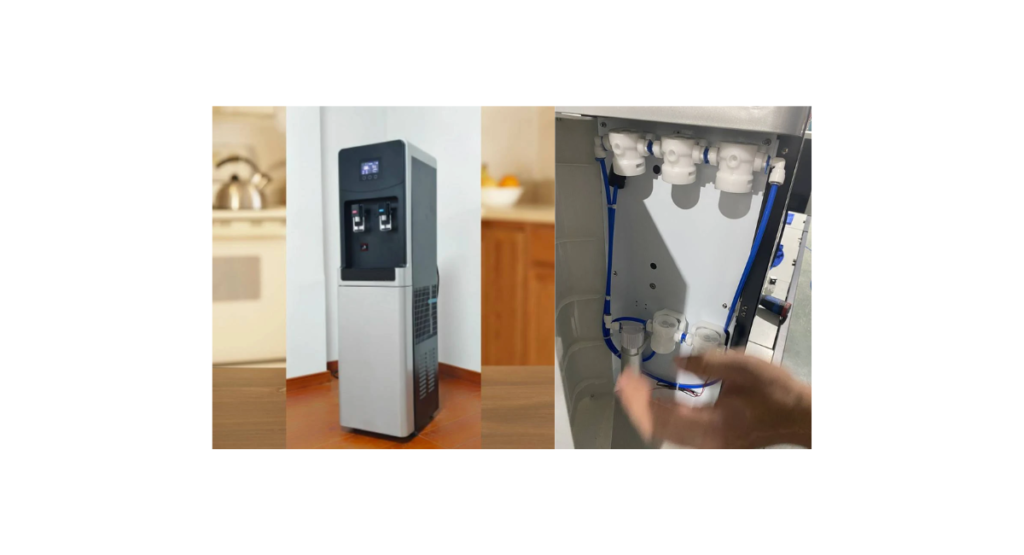
This is the dominant home AWG technology and the most practical for producing meaningful daily output. A hermetic compressor cools an evaporator coil to 45–52°F (7–11°C), below the ambient dew point, causing water vapour to condense. Condensate passes through a sediment-carbon-UV filtration stack before reaching the tap.
Pros: High output (2–20+ L/day depending on unit size and humidity), proven technology with decades of refrigeration reliability data, can be built as a DIY project. Cons: Requires 90–400W of continuous power, does not operate efficiently below 60°F (15°C) ambient or below 50% RH.
For a detailed look at how this system works internally, see the atmospheric water generator mechanics explainer.
2. Peltier / Thermoelectric
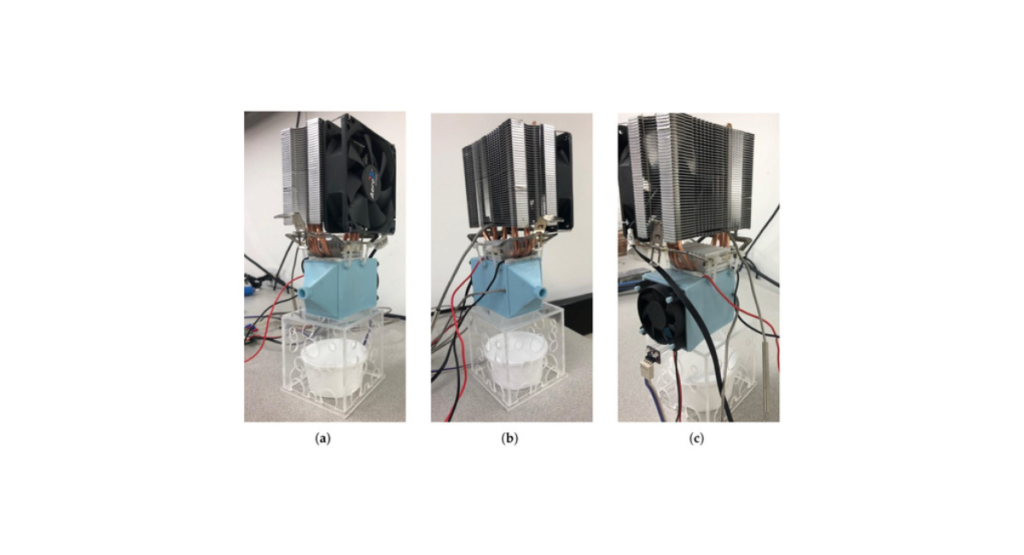
Peltier-based AWGs use solid-state thermoelectric modules to create a cold surface rather than a compressor. They are quieter, have no moving parts, and are cheaper to manufacture — which is why they dominate the $300–$600 countertop market. However, their coefficient of performance (COP) is significantly lower than compressor-based units, meaning they use far more electricity per litre produced.
A typical Peltier AWG produces 0.5–2 L/day even at 80°F (27°C) and 80% RH. For households that need more than a litre or two per day, Peltier units are not a viable primary option. They are best understood as premium drinking-water supplements — a clichéd “tech gadget” purchase that underdelivers on the core use case for most buyers.
3. Desiccant-Based
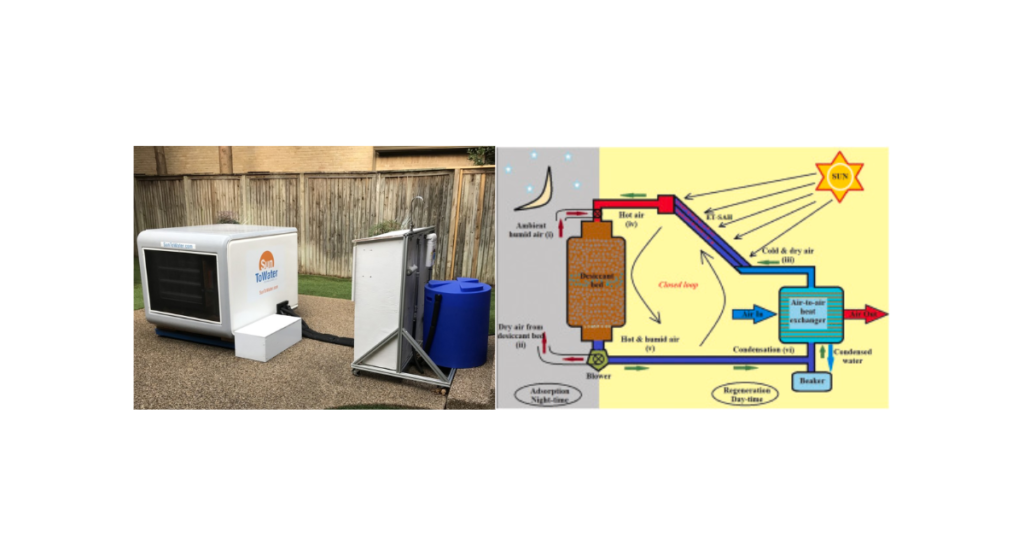
Desiccant AWGs use hygroscopic materials (silica gel, zeolite, or liquid desiccants) to capture water vapour from air, then apply heat to release it as liquid water. Their advantage vis-à-vis compressor-based systems is that they can operate at lower relative humidity — some designs claim production at 30–40% RH — making them relevant in arid climates where compressor units fail.
The trade-off: desiccant regeneration requires a heat source (solar thermal or electric), and energy requirements per litre produced are typically higher than compressor-based designs in moderate to high humidity environments. Desiccant AWGs are an active research area. A 2021 review in Renewable and Sustainable Energy Reviews identified liquid desiccant systems as the most promising path for arid-region water harvesting, with prototype systems achieving 1–3 L/day per square metre of desiccant surface area in 30–45% RH conditions.
4. Solar-Passive (Radiative Cooling / SOURCE Hydropanels)
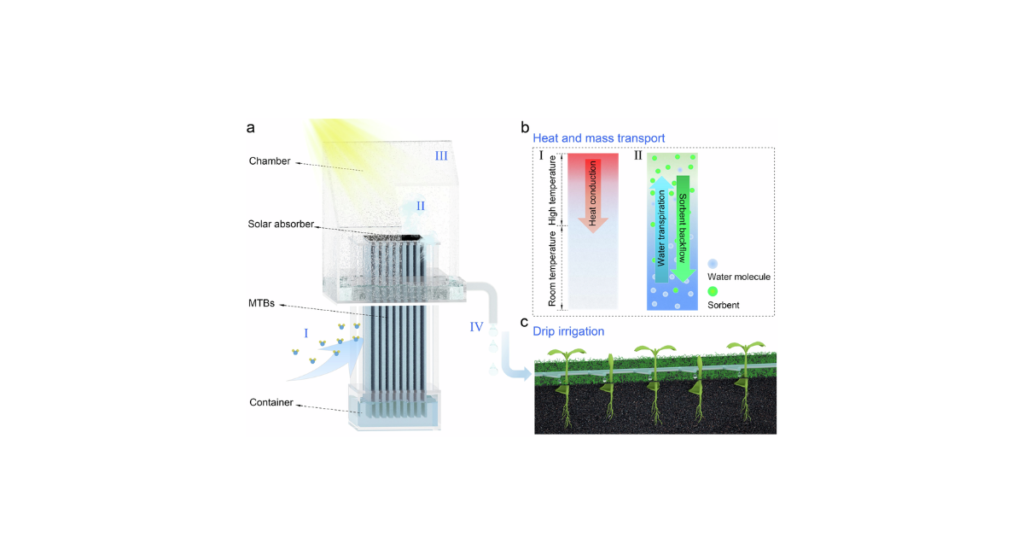
A newer category that harvests atmospheric water using solar energy alone — no grid electricity required. SOURCE Hydropanels, developed by Zero Mass Water (now rebranded as SOURCE), use a proprietary hygroscopic material that captures water vapour during the day and releases it as liquid when solar heat is applied. A single panel produces approximately 2–5 litres per day in moderate humidity (30–60% RH) with zero electricity cost.
Priced at $2,000–$3,000 per panel installed, SOURCE Hydropanels carry a premium but deliver genuine off-grid capability and have been evaluated under NSF standards for water quality. They are the right choice for truly remote off-grid locations where any electricity generation adds cost — not for urban households seeking to cut a water bill.
Key Specs to Evaluate (and What Manufacturers Obscure)
Output at Your Conditions, Not Peak Rated Output
Manufacturers state rated output at reference conditions — typically 86°F (30°C) and 80% RH. In real U.S. homes operating at 72°F (22°C) and 55% RH, output is typically 40–60% below the rated figure. Always ask for or look up a unit’s performance curve at your expected ambient conditions. A unit rated at 10 L/day at 86°F (30°C) / 80% RH may deliver only 4–5 L/day in your actual indoor environment.
Energy Efficiency: kWh per Litre
Energy use per litre produced is the key operating cost metric. Compressor-based residential AWGs typically achieve 0.3–0.8 kWh/L at moderate humidity. Peltier units consume 1–3 kWh/L — 3×–10× less efficient. At the U.S. average residential electricity rate of $0.17/kWh, the difference between a 0.4 kWh/L unit and a 2.0 kWh/L unit is $0.07 vs. $0.34 per litre just in electricity — a 5× difference in operating cost that compounds dramatically over years.
Filtration Certification
Look for NSF/ANSI certification on filtration components: NSF/ANSI 42 covers aesthetic effects (taste, odour, chlorine reduction); NSF/ANSI 53 covers health effects (lead, cysts, VOCs); NSF/ANSI 55 Class A covers UV microbiological treatment. Units that carry all three certifications — or use components that do — have been independently verified to reduce the contaminants their labels claim. Units that do not carry NSF certification are relying on their own testing claims alone.
Minimum Operating Humidity and Temperature
Compressor-based units typically require 50%+ RH and 60°F (15°C) or above for useful output. Units marketed for use “anywhere” are rarely honest about their performance below these thresholds — a compressor-based AWG at 40% RH and 55°F (13°C) produces near-zero output regardless of what the marketing says. Check the NOAA Climate Data Online portal for your location’s monthly average humidity and temperature before purchasing.
Noise Level
Compressor-based AWGs produce noise comparable to a small window AC unit: 45–58 dB depending on compressor size and housing design. This matters significantly for kitchen or bedroom placement. If noise is a concern, look for units with vibration-damping compressor mounts and fan speed control, or plan placement in a utility room or garage.
Home AWG Options by Budget
Under $500: DIY Build + Blueprint
The best value in the home AWG category for anyone willing to invest 15–20 hours of build time. A compressor-based DIY build using a 1/8–1/4 HP hermetic compressor, copper evaporator coil, and 3-stage filtration stack costs $200–$400 in parts. A tested blueprint (such as the Smart Water Box) adds $30–$60 and provides exact component specifications, refrigerant charge weights, and filtration stack configurations validated for drinking-water output. Total all-in: $230–$460.
Expected output in a 72°F (22°C) / 60% RH home environment: 2–4 L/day. Energy consumption: 90–120W. 5-year cost of ownership: $900–$1,100 including electricity and filter replacements. This is the lowest-cost path to a functional home AWG that meets WHO and EPA drinking water quality standards.
$500–$1,500: Entry-Level Commercial Residential
Plug-and-play compressor-based units targeting the single-person to couple household. These units typically deliver 3–8 L/day at reference conditions (or 2–4 L/day in moderate U.S. indoor environments), include a 3–5 stage built-in filtration system, and require only a standard 120V outlet. Most include a 1-year warranty. Key advantages over DIY: no build time, professional aesthetics, and warranty coverage. Key disadvantage: higher upfront cost and proprietary filter cartridges that may cost more than generic equivalents.
$1,500–$3,500: Mid-Range Family-Sized
The sweet spot for family households targeting 8–20 L/day. Units in this range typically use 1/4–1/2 HP compressors, include 5–7 stage filtration systems, and often carry NSF/ANSI certification on at least the filtration components. Some include built-in cold/hot water dispensing. At 80°F (27°C) and 70% RH, a well-engineered mid-range unit produces enough water to cover daily drinking needs for a family of 4 with surplus for cooking.
$2,000+: Premium and Solar-Powered
This category covers two distinct sub-segments: high-output premium residential units ($2,000–$5,000) with industrial-grade compressors and stainless-steel internals designed for 10+ year service life, and solar-passive units such as SOURCE Hydropanels ($2,000–$3,000 per panel) that operate entirely on solar energy without grid electricity. The right choice within this tier depends entirely on whether your primary goal is high output or grid independence.
Installation and Space Requirements
Most residential AWGs are designed for indoor placement and require minimal installation:
- Countertop units: Plug into a standard 120V outlet; no plumbing. Footprint 12″×12″ to 16″×20″.
- Floor-standing units: Plug-in or hardwired 120V/240V. Footprint 18″×18″ to 24″×30″. Require 18–24 inches of clearance around air intake and exhaust vents.
- DIY builds: Flexible; can be sized and shaped to your available space. Most compact builds use a 12″×18″ to 18″×24″ enclosure footprint.
- SOURCE Hydropanels: Roof or ground-mounted; no indoor space required. Each panel covers approximately 3.3 ft² and requires clear solar exposure.
All indoor compressor-based units heat the room slightly — the condenser rejects heat to the ambient air, similar to a window AC unit running in reverse. In a small room (under 200 sq ft), this effect is noticeable at 65–75°F (18–24°C) ambient. In larger spaces it is negligible. If your unit is in a well-ventilated space, the heat rejection is a non-issue.
Running Costs and Maintenance Schedule
Ongoing ownership costs for a home AWG:
| Cost Item | DIY Build | Commercial Unit | Frequency |
|---|---|---|---|
| Electricity (100W unit, $0.17/kWh) | $4.00–$5.00/month | $5.00–$15.00/month | Ongoing |
| Sediment filter cartridge | $5–$10 | $10–$25 | Every 3–6 months |
| Activated-carbon cartridge | $10–$18 | $15–$35 | Every 3–6 months |
| UV lamp replacement | $15–$30 | $25–$60 | Annually |
| Collection tank sanitisation | $1–$2 (bleach) | Included in filter kit | Monthly |
| Annual total (filters + electricity) | $100–$150 | $130–$300 |
The CDC’s household water treatment guidance recommends testing point-of-use water systems periodically for microbial contamination. A basic coliform and turbidity test from a state-certified EPA laboratory costs $30–$80 and is worth running annually, particularly in the first year of operation while you establish that your filtration stack is performing correctly.
Three Questions to Ask Before Buying
1. What is my actual average indoor humidity?
Not your outdoor seasonal average — your indoor average during the months you plan to run the unit. Indoor humidity varies significantly based on your HVAC system and local climate. A $20 hygrometer left in your intended AWG location for a week gives you the ground truth. If your indoor RH is consistently below 50%, a compressor-based AWG will underperform regardless of how much you spend on the unit.
2. How many litres per day do I actually need?
The WHO minimum drinking water requirement is 2 litres per person per day for basic survival; a comfortable daily allowance for drinking and food preparation is 3–5 litres per person. A family of 4 targeting drinking water plus cooking needs approximately 15–20 litres per day from all sources — far more than any single compact AWG can supply. Be clear about whether you are seeking a supplemental source (2–5 L/day is useful) or a primary source (15+ L/day requires a mid-range or larger unit, or multiple units).
3. Am I optimising for convenience or lowest long-term cost?
These two goals point in opposite directions. Convenience means a commercial plug-and-play unit with warranty support and proprietary filter kits. Lowest long-term cost means a DIY build with generic replacement cartridges and a validated blueprint. Neither approach is wrong — but conflating them produces a naïve decision. I recommend being explicit about which matters more before you start shopping.
The Lowest-Cost Home AWG Path in 2026
If you are optimising for lowest all-in cost and are willing to invest a weekend or two, the Smart Water Box blueprint delivers entry-commercial-grade output at DIY parts prices — with exact component specs and a filtration stack validated for drinking-water quality.
Where to Go Next
- Residential AWG Buyer’s Guide — deeper comparison of specific commercial units by category
- Are Atmospheric Water Generators Worth It? — the honest 5-year value analysis with break-even math
- Is Tap Water Safe to Drink? — understanding what an AWG replaces and why water source independence matters
Frequently Asked Questions
How much water can a home atmospheric water generator produce per day?
Output depends primarily on ambient temperature and humidity. At 72°F (22°C) and 60% RH — typical U.S. Southeast or Gulf Coast indoor conditions — a compact residential unit (90–120W compressor) produces 2–4 L/day; a mid-range unit (200–350W) produces 6–12 L/day. At 85°F (29°C) and 75% RH (Florida, Texas Gulf Coast, Hawaii), a compact unit produces 4–7 L/day and a mid-range unit 12–20 L/day. At lower humidity (45% RH), both outputs fall by 50–70%.
Does an atmospheric water generator work in dry climates?
Standard compressor-based AWGs do not produce meaningful output below 40–45% RH. In genuinely arid climates (Phoenix, Las Vegas, Albuquerque), a desiccant-based AWG or a solar-passive system like SOURCE Hydropanels is a more appropriate technology. Compressor-based AWGs are best suited for humid coastal, tropical, and temperate-humid inland climates.
Is an atmospheric water generator the same as a dehumidifier?
The underlying condensation mechanism is the same, but the purpose and design are different. A dehumidifier is designed to remove moisture from indoor air to control humidity — its collection tank is not food-safe and its water output contains concentrations of whatever contaminants were in the air. An AWG is designed to produce safe drinking water — it uses food-grade collection surfaces, a multi-stage filtration stack, and often UV sterilisation. Using a standard dehumidifier as a drinking water source is not recommended by the CDC or EPA without additional treatment.
What filtration does a home AWG need to make the water safe to drink?
At minimum: a 5-micron sediment pre-filter, an activated-carbon block (NSF/ANSI 42 and 53 certified where possible), and a UV steriliser delivering 40 mJ/cm² at your flow rate (NSF/ANSI 55 Class A certified). This combination addresses turbidity, VOCs, chlorine by-products, bacteria, viruses, Cryptosporidium, and Giardia — the primary concern categories identified in the WHO Guidelines for Drinking-water Quality. In areas with known heavy metal contamination in the air (industrial neighbourhoods, wildfire smoke zones), a reverse osmosis membrane stage adds meaningful protection.
Can I use an atmospheric water generator as my only water source?
In high-humidity climates and with a sufficiently large unit, yes — for drinking and cooking water. A family of 4 requires 15–20 litres per day for drinking and food preparation. A mid-range compressor AWG (200–350W) operating at 75°F (24°C) and 65% RH can realistically meet that need. Bathing, laundry, and sanitation use far more water (80–100 gallons per person per day in a standard U.S. household per the EPA WaterSense program) — no residential AWG can supply that volume from atmospheric condensation alone. AWGs are practical as a primary drinking and cooking water source in humid climates, not as a whole-home water replacement.
Leave a Reply